


The COCOBOD scholarship for children of Ghana's cocoa farmers
By Farouk Yahaya · Updated 5 October 2026
The Ghana Cocoa Board, generally called COCOBOD, has run a scholarship scheme for the children of registered cocoa farmers since the 1950s, which makes it one of the longest-running sector-specific schemes in West Africa. It is not widely known outside the cocoa-growing areas. If your parent supplies cocoa to a Licensed Buying Company, it is probably the most direct route to funded education open to you.
The farming community it serves is large: COCOBOD’s own figure is over 800,000 farmers across six regions, and many of their children have gone through secondary and tertiary education on the scheme.
What COCOBOD is
COCOBOD is the statutory regulator of Ghana’s cocoa sector. It was established in 1947 and has been restructured several times since. It buys cocoa from Licensed Buying Companies, processes some of it in Ghana, exports the rest, and puts part of the revenue back into farmer welfare. Scholarships are one of the oldest of those welfare lines, alongside farmer pensions, replanting subsidies and chemical distribution. COCOBOD presents the scheme as recognition of what cocoa farmers contribute to the national economy.
What the scholarship covers
| Senior High School award | Tertiary award | |
|---|---|---|
| Pays for | School fees, boarding, books and uniform | University or polytechnic fees, plus smaller cash allowances for books and personal expenses |
| Where | A public Senior High School | An accredited Ghanaian public tertiary institution |
| How long | The length of the SHS programme | The length of the first degree |
| Size of pool | Larger, by number of awards | Smaller and more competitive |
Fees are paid directly to the institution, not to the family. Cash allowances go into the student’s own bank account once one has been opened. Awards are renewed each year provided the student progresses academically; a student asked to repeat a year for academic reasons will usually lose the renewal for that cycle.
In recent cycles COCOBOD has added special awards for top-performing children of cocoa farmers, including limited support for overseas study in priority fields, and internship and apprenticeship support for tertiary students placed with COCOBOD or its affiliated organisations during the long vacation. The current scholarship circular on the COCOBOD website gives the exact award amounts for the year.
Who is eligible

Parentage is the defining requirement. You must be the biological child or legal ward of a registered cocoa farmer, meaning one whose name is on the records of a Licensed Buying Company (LBC) that supplies COCOBOD. You will be asked for proof: a passbook, a Farmer ID or an attestation from the LBC.
The other requirements are:
- Ghanaian citizenship, shown by your Ghana Card
- for SHS awards, admission to a public Senior High School in Ghana, shown by the admission letter
- for tertiary awards, admission to an accredited Ghanaian public tertiary institution
- minimum grades, historically Aggregate 24 or better in the BECE for SHS entrants and Aggregate 12 or better in the WASSCE for tertiary entrants
- no double funding: applicants already on a full GETFund, MTN or similar award may be deprioritised, although a partial award does not rule you out
Priority goes to first-generation tertiary applicants and to children of smallholder farmers (under five hectares). Children of large-scale farmers, or of farmers with other significant income, may be assessed differently.
When applications open
The cycle follows the Ghanaian academic calendar. The usual pattern is:
| Award type | Typical opening | Typical deadline |
|---|---|---|
| SHS new entrants | June to August (after BECE results) | Four to six weeks after announcement |
| SHS continuing students | July to September | Aligned with new entrants |
| Tertiary new entrants | August to October (after WASSCE / university admission) | Four to six weeks |
| Tertiary continuing students | August to October | Aligned |
Notices appear on the COCOBOD website at cocobod.gh, usually under “Programmes” or “Farmer Welfare”, and are also passed through LBC offices and their purchasing clerks, district directorates of education, and the Daily Graphic and Ghanaian Times.
In farming communities the LBC purchasing clerk often hears about the new cycle first, sometimes before the notice is online, and often has the paper forms. Ask the clerk wherever your parent sells cocoa.
COCOBOD does not publish acceptance figures. Because eligibility is limited to children of registered cocoa farmers, the scheme draws a smaller pool than GETFund or MTN Bright. Within that pool, the SHS stream has the most awards and the tertiary stream is more competitive.
Confirming your parent’s status
Start here, because this is where many applications fall down. Check with your parent that they are registered with a Licensed Buying Company, that they have a Farmer ID, passbook or LBC record showing the supply relationship, and that they can produce it when asked. If the registration has lapsed, they should re-register with their LBC before the window opens; the clerk can help with this.
If your parent sells through more than one LBC, use the one with the longest relationship for your documents, since frequent switching can leave the records unclear.
Documents
- Your Ghana Card
- Your parent's farmer documentation: Farmer ID, passbook or LBC attestation
- A birth certificate showing the parent-child relationship
- Your most recent results: BECE results for SHS applicants; WASSCE results and admission letter for tertiary applicants
- Two passport-sized photographs
- One reference letter from a current or former school
Have your results slip officially stamped by your school before you submit, as unstamped or photocopied slips risk being refused. Tertiary applicants should get their admission letter as early as possible, because COCOBOD will not process a tertiary application without it.
Submitting the application
COCOBOD has been moving to an online portal, which is announced on its website each cycle, but paper applications through district directorates are still accepted in remote areas. There, going through your parent’s purchasing clerk, who often has the forms, can be quicker than the central portal.
Fill in every field accurately. The verification team checks your parent’s LBC and farmer ID number first, so get those exactly right. Make sure you are using the correct stream, since SHS and tertiary applications are separate and a tertiary applicant who files on the SHS form will be rejected. Give the district where your parent sells cocoa, not the district where you live, because verification is routed through the purchasing district.
Verification
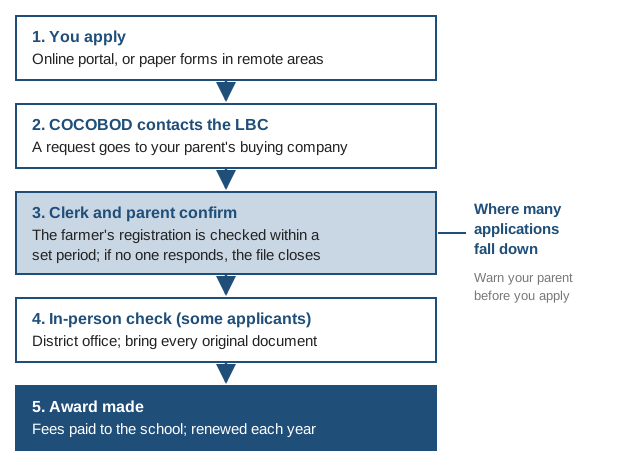
After you submit, COCOBOD sends a verification request to the relevant LBC to confirm your parent’s status. The clerk has a set period to respond, and if your parent does not come forward in time the application closes, so warn them in advance that the request is coming. Delays at this stage are a frequent cause of rejection.
Some applicants are then called for in-person verification at the district COCOBOD or education office. Bring the originals of everything you submitted as scans; failing verification here means losing the award. COCOBOD checks parent status with the LBC in earnest, and falsified documents can lead to an applicant being barred.

Further sources
- the official COCOBOD site, cocobod.gh, under “Programmes” or “Cocoa Farmer Welfare”
- LBC purchasing clerks in farming communities, who are the first source of information for many farming households
- district directorates of education, for the SHS stream in particular
- the Ministry of Food and Agriculture cocoa unit, for sector-wide notices and policy changes
An unsuccessful applicant can reapply in the next cycle. Since verification documents are a common reason for rejection, that is the part to strengthen. If you are heading to university, the GETFund guide covers the largest government scheme; bear in mind the double-funding rule above.