


Commonwealth Master's Scholarships 2027/28
One-year taught Master's at a UK university, for citizens of eligible Commonwealth countries

- Funder
 Commonwealth Scholarship Commission in the UK
- Study in
- United Kingdom
- Level
- Master's
- Funding
- Full
- Closes
- 20 Oct 2026 7 days left The CSC Central form closes at 16:00 BST on 20 October 2026. Your nominating agency runs its own process and may set an earlier deadline, so check it first.
- Official site
- cscuk.fcdo.gov.uk
Checked on cscuk.fcdo.gov.uk by Farouk Yahaya, 6 October 2026. Scholarly Dream is independent and not affiliated with this funder.
Commonwealth Master’s Scholarships pay for a one-year taught Master’s at a UK university for people from low and middle-income Commonwealth countries who could not otherwise afford to study in the UK. They are run by the Commonwealth Scholarship Commission in the UK (CSC) and paid for by the Foreign, Commonwealth and Development Office. The CSC offers around 800 awards a year across all its schemes, and this is its main route for taught postgraduate study.
The 2027/28 round is open now and the CSC’s form closes at 16:00 BST on Tuesday 20 October 2026 (checked 6 October 2026 on the official page). Courses start in September or October 2027.
One award, two applications
The CSC does not accept applications sent straight to it. Every candidate is put forward by a nominator: either the national nominating agency for your country, which is usually a ministry of education or a scholarships board, or one of a short list of non-governmental organisations that nominate particular groups. You complete the CSC’s own form on its CSC Central portal, and you also go through whatever process your nominator runs, which can mean a second form, extra documents, an interview and an earlier closing date.
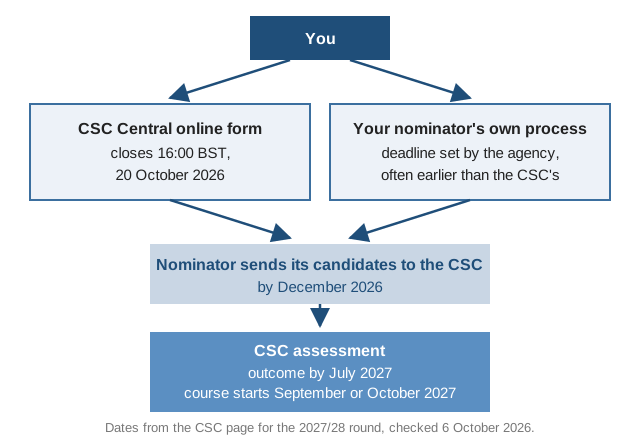
The 20 October date applies to the CSC Central form. Nominators then have until December 2026 to send their chosen candidates to the CSC, and many finish their own shortlisting well before that. Look up your agency on the CSC’s national nominating agencies page as soon as you decide to apply. For Ghana it is the Ghana Scholarships Secretariat, for Nigeria the Federal Scholarship Board in Abuja and for Pakistan the Higher Education Commission. Each sets its own criteria, and the CSC asks that questions about an agency’s process go to the agency, not to the CSC.
What it pays
| Item | What the CSC provides (checked 6 October 2026) |
|---|---|
| Tuition | Full fees, paid under an agreement between the CSC and the university |
| Stipend | £1,712 a month, or £2,000 a month at universities in the London metropolitan area |
| Flights | Approved airfare from your home country to the UK and back at the end of the award |
| Study travel grant | A contribution towards study-related travel in the UK or abroad |
| Child allowance | For widowed, divorced or single parents whose children live with them: £622 a month for the first child and £154 a month for the second and third, under 16 |
There is no allowance for a spouse or partner, and the child allowance is only for single parents. Scholars may not hold another award covering the same costs, must ask the CSC before taking paid work or travelling outside the UK during the award, and are expected to return home when it ends.

Who can apply
- A citizen of an eligible Commonwealth country, a person granted refugee status by one, or a British Protected Person
- Permanently resident in an eligible Commonwealth country
- Holding, by September 2027, a first degree at upper second class (2:1) or better, or a lower second class (2:2) degree plus a relevant postgraduate qualification
- Unable to afford to study in the UK without the scholarship
- Available to start the course in September 2027
- Not an employee, former employee or relative of an employee of the UK Government, not a staff member of the British Council or the Association of Commonwealth Universities, and not a Commonwealth Scholarship Commissioner or a Commissioner's relative
The list of eligible countries for 2027/28 has 43 entries, among them Bangladesh, Ghana, India, Jamaica, Kenya, Malawi, Malaysia, Nigeria, Pakistan, Rwanda, Sierra Leone, South Africa, Sri Lanka, Tanzania, Uganda, Zambia and a number of small island states. High-income members such as Australia, Canada, New Zealand and Singapore are not on it. The list can change between rounds, so confirm your country on the official page first.
Employment experience is not required, which separates this award from Chevening. The CSC does not ask for an IELTS certificate, though your university may.
Disabled applicants who can show their potential to contribute to development but who do not hold a 2:1 may be considered for what the CSC calls a contextualised nomination, made through the Commonwealth Disabled People's Forum rather than a national agency.
What the CSC funds, and what it does not
Funded
- Full-time, one-year taught Master's courses
- Courses at UK universities that have signed a memorandum of understanding with the CSC (91 universities were on the list on 6 October 2026)
- Up to three course choices, listed in order of preference
- Study tied to one of the CSC's six development themes
Not funded
- MBAs
- Research Master's degrees
- Two-year programmes, part-time study or a second course after the first
- Distance learning, which has its own CSC scheme
Partner universities cover 20 per cent of the overseas tuition fee, which is why only they can host a scholar. The six themes are science and technology for development; improving population health, health systems and capacity; promoting innovation and entrepreneurship; strengthening peace, security and governance; strengthening resilience and response to crises; and access, inclusion and opportunity. Your plan should sit under one of them without strain.

How the CSC scores applications
The CSC publishes three criteria and the evidence it weighs under each.
Candidate merit. Examination results, transcripts and what your referees write. Prizes, professional development and career achievements count as secondary evidence.
Quality of the plan of study. What you want to learn, how it serves your objectives, and signs that you have researched the course and institution down to the module options. An existing offer and clear writing help, but neither is the main test.
Development impact. How the course answers a need in your sector or country, the outcomes you expect, when, and for whom, and how you will apply the new skills. Leadership, advocacy, volunteering and a fit with national priorities or the CSC themes are secondary.
The impact statement is where vague writing costs the most. The pair below is illustrative, with an invented applicant.
After completing my Master's in public health I will return home and use my knowledge to strengthen the health system and help my country achieve the Sustainable Development Goals.
Within two years of returning to the regional health directorate in Tamale, where I manage immunisation data for 112 facilities, I will redesign the cold-chain stock report and train the 16 district officers who complete it. The test of success is whether stock-out reports reach the directorate within a week rather than the current month.
The 2027/28 round
- Now to 20 October 2026Complete the CSC Central form. Your nominator's own closing date may fall before this.
- By December 2026Nominators send their chosen candidates to the CSC. Candidates who were not nominated go no further.
- December 2026 to July 2027The CSC assesses nominations against the three criteria. The CSC does not publish an interview stage of its own, though some agencies interview before nominating.
- By July 2027Outcomes go out by email.
- September or October 2027Courses begin.
Nominators that are not governments
Six organisations nominate alongside the national agencies, each for a defined group: the Canon Collins Trust for southern Africa, the Commonwealth Disabled People’s Forum for disabled candidates, The Commonwealth Equality Network for candidates whose study will improve the position of LGBTI+ people, the Forum for African Women Educationalists for women from Africa, the HALI Access Network for low-income students from Africa, and Windle Trust International for refugees and people affected by conflict. It is your job to check that you fit an organisation’s remit, and Windle Trust asks for a separate application of its own.

Before you open the form
- Confirm your country is on the 2027/28 list and identify your nominator. Note its deadline.
- Choose up to three one-year taught Master’s courses at partner universities and start the admission applications. The CSC says to apply for admission before you apply for the scholarship, or as soon as possible afterwards.
- Gather the documents the CSC requires: a passport or national identity card showing your photograph, date of birth and citizenship; full transcripts, with certified translations where needed; and at least two signed references as PDFs.
- Create a CSC Central account, complete the form and submit before 16:00 BST on 20 October 2026.
- Complete your nominator’s process by its own closing date.
If you have several years of work behind you and would rather apply without a nominator, Chevening is the natural comparison. If your field is well taught elsewhere in the Commonwealth, the Queen Elizabeth Commonwealth Scholarships fund study in another low or middle-income member country. Our guide to writing a motivation letter helps with the plan of study. Confirm every date and figure on the official CSC page before you submit.