


Guides
How to find and apply for scholarships, profiles of the big funders, and printable checklists and templates. Written by Farouk Yahaya and Ziad Maltiti.
Finding and funding scholarships
- How to appeal or negotiate a scholarship or financial aid offer
Some funding offers can be reconsidered and some cannot. When an appeal is worth making, who to write to, what evidence to send, and how to word the request.
- FAFSA and CSS Profile: what each form is and who needs them
The two main financial aid forms for US colleges explained: who runs each one, what aid it unlocks, what it costs, the 2027-28 dates, and what applies if you are not a US citizen.
- Chevening, DAAD EPOS and Erasmus Mundus compared
Three well-known fully funded Master's routes compared on the things that decide fit: the profile each selects for, the eligibility rules, the plan it expects and how the application runs.
- Finding scholarships you are eligible for
Checking eligibility before anything else saves weeks of wasted applications. How to filter awards against your own details, where to look, and how to rank what is left.
- How to spot and avoid scholarship scams
Scholarship scams are built to look legitimate and can cost you money or your personal data. An annotated example of a fake award message, the usual warning signs, and how to check an award before you act.


Statements, CVs and references
- What to do after a scholarship rejection
A rejection email is information as well as bad news. What to do in the first two days, when to ask for feedback and how, how to review your own application, and what to change before you apply again.
- Writing a scholarship motivation letter
Grades get an application considered; the motivation letter is where a committee decides whether to fund the person behind them. How to open, how to link the award to a plan, and what to cut.
- Writing a personal statement for postgraduate study
What admissions readers check in a Masters or PhD personal statement, a four-part structure that covers it, an annotated sample paragraph and a checklist to run before you submit.
- How to write an academic CV
An academic CV works to different rules from a business one. The sections to include, how to order them for a particular post, an annotated sample and the mistakes that weaken an otherwise good record.
- How to ask for a strong recommendation letter
A good reference can help an application and a weak one can hold it back. Choosing referees, when to ask, a sample request to adapt and the information pack that helps them write a specific letter.


Interviews
- How to prepare for a scholarship panel interview
What scholarship interview panels are usually assessing, the questions that come up again and again, sample answers with weaker and stronger versions, and how to practise so you sound natural on the day.
- How to prepare for a video or online interview
Checking your equipment and connection, setting up the room and the camera, where to look, and what to do when the line lags or drops during an interview over video.
- How to handle interview nerves
Some nervousness before an interview is normal and can even sharpen your focus. Practical ways to keep it at a level that does not get in the way of your answers, from the week before to the moment your mind goes blank.


Master's and PhD study
- How to choose the right Masters programme
A Masters takes one to two years and a lot of money. How to compare programmes on goal, curriculum, funding, supervision, outcomes and cost, with a sample comparison grid and a message to send to current students.
- How to choose where to do a PhD
For a doctorate, the supervisor, the research group, the project and its funding usually count for more than the university's reputation. What to find out before you accept a place, the questions to ask current students, and the warning signs.
- How to find and apply for a funded PhD
Funded PhDs are advertised and decided differently from taught courses. The two routes to funding, where positions are listed, how to approach a supervisor and what goes in the application.
- Master's or PhD?
A Masters and a PhD are very different commitments with different payoffs. A side-by-side comparison, a simple way to work back from your goal, and how to tell which one your plans call for, if either.
- How to email a potential PhD supervisor
For many PhDs the first step is an email to a researcher. What that message should contain, what to attach, a sample to adapt, and what to do if nobody replies.


Studying abroad
- Student visa basics
What to organise for a student visa once you accept an offer: a timeline from offer to arrival, the usual documents, proof of funds, interviews and accuracy. General principles; always check the official guidance for your destination.
- How to prove funds for a student visa
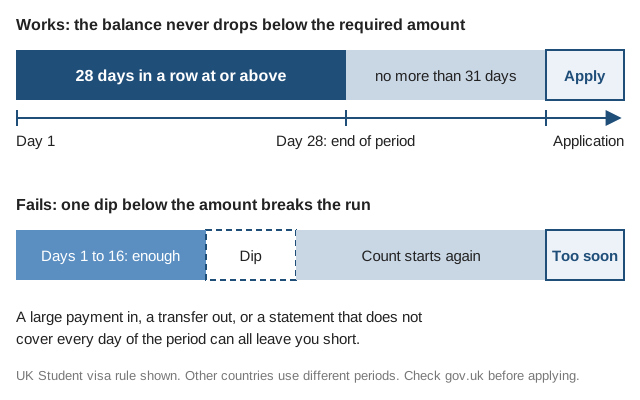
Proof of funds is a frequent reason for student visa refusals. The three rules to check for your destination (amount, form of evidence, holding period), current figures for the UK, Canada, Australia and the US, and an annotated sample bank statement.
- How to choose which country to study in
The country you study in affects what the degree costs, whether you can work afterwards and what daily life is like. The points worth comparing, where to check them, and how to set a shortlist side by side.
- Working while you study as an international student
What to check before taking a part-time job on a student visa: your work rights, how many hours you can manage, what kind of work to look for, and the tax and record-keeping side.
- Studying in the UK
Course lengths, tuition and living costs, the main scholarship routes such as Chevening, Gates Cambridge and Rhodes, what the Student visa asks you to show, post-study work, and practical points for international students considering the UK.



The big scholarship funders
- Chevening
The UK Government's scholarship for emerging leaders
- DAAD
Germany's academic exchange service
- Mastercard Foundation
Scholarships for young Africans through partner universities
- Erasmus Mundus
EU-funded joint Master's across multiple countries
- Rhodes Trust
The oldest international graduate scholarship, at Oxford
Checklists and templates
- Scholarship application checklist Checklist
The documents to gather and the checks to make before you submit a scholarship application.
- Motivation letter planner Worksheet
Prompts for planning a motivation letter paragraph by paragraph, which you then write in your own words.
- Academic CV structure Template
The sections a scholarship or academic CV usually needs, in a sensible order, with what belongs in each.
- Reference request email Template
A sample email asking someone for a reference, and the documents to send with it.
- Scholarship interview preparation sheet Worksheet
Questions scholarship panels commonly ask, with notes on preparing answers in your own words.
- Questions to ask before accepting a scholarship Checklist
Points to check about cover, conditions and fit before you accept a scholarship offer.
- Financial aid appeal letter Template
A letter asking a university to look again at a scholarship or aid offer, with the evidence to attach.
- Reply to a rejection and ask for feedback Template
A short, gracious reply to a scholarship rejection, with an optional request for feedback.