


How to write a CV that gets shortlisted
By Ziad Maltiti · Updated 5 October 2026

A recruiter often spends only a few seconds scanning a CV before deciding whether to read on, and in many organisations software screens it before any person sees it. Getting shortlisted depends less on listing everything you have done than on making the relevant parts easy to find for both.
Adapting it to each role
A frequent reason CVs fail is that the same version was sent to every job. Employers can tell, and so can the screening systems many of them use. Read the job description, work out what the role needs, and make sure your CV shows those things clearly and near the top. Nothing needs to be exaggerated; the work is in deciding which parts of your experience to put first.
A quick way to do this: copy the advert into a document and highlight the requirements, then the skills and the duties it mentions more than once. Those are what the person shortlisting has been told to look for. For each one, find the line in your CV that shows it, and if there is none, decide whether you have the experience and have not written it down.
Keep a full “master” CV with everything on it, and cut a copy for each application. Adapting then becomes a matter of choosing and reordering, not rewriting from scratch.
What goes at the top of page one
Recruiters read in a quick sweep, and the top of the first page gets the most attention. Whatever is there decides whether the rest is read.
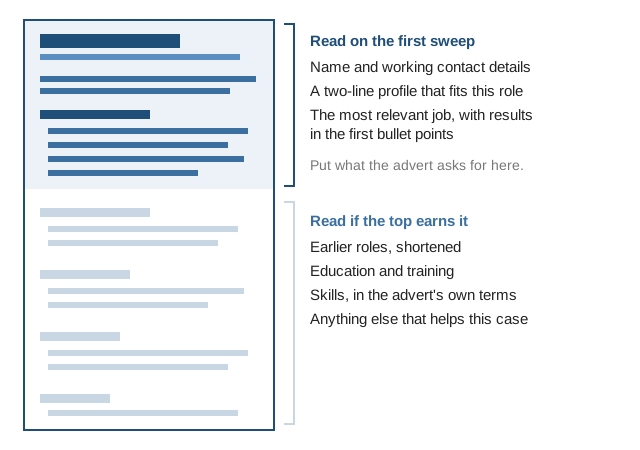
A short profile of two or three lines can help if it is specific: the kind of role you do, your main area of experience and one result. “Motivated team player seeking a challenging role” wastes the most valuable space on the page.
Results instead of duties
Anyone who held your previous job had the same responsibilities, so what distinguishes you is what you achieved. Wherever you can, turn a duty into a result. “Responsible for social media” says less than a line about how the audience grew or engagement rose by a clear amount. “Managed a team” says less than what the team delivered under you. Use numbers where you have them, because a specific figure carries weight.
The examples above are illustrative. If you do not have a number, describe the change plainly. A rough way to build each bullet point is: what you did, how you did it, and what happened as a result. Start with a verb (set up, reduced, trained, wrote) and keep it to one or two lines.
Layout
Arrange the page for a quick sweep: clear headings, short bullet points and consistent formatting, with the most relevant experience where the eye lands first. Dense paragraphs, unusual fonts and clever layouts can confuse both human readers and screening software, and for most roles a clean, plain design works better than a creative one.
A few practical points:
- use one readable font throughout, in a normal size
- keep the same date format for every entry, aligned in the same place
- list experience in reverse order, most recent first
- leave enough white space between sections that each heading is easy to find
Screening software

Many employers use systems that scan CVs before a person sees them. To get through them:
- use the keywords and phrasing from the job description where they accurately describe you
- keep to a standard, simple layout that software can read
- do not put key information only inside images, tables or headers, which some systems miss
Use standard section headings such as “Experience”, “Education” and “Skills”, and write out a term in full at least once if the advert uses it that way. Send the file format the advert asks for. If it does not say, a document saved from a word processor is safer than a scanned page or an image, which software may not be able to read at all.
Length
For most non-academic roles, one to two pages is normal. That is enough to show your relevant experience without burying it. Old, minor or unrelated roles can be cut to a single line or removed, and anything left on the page should help your case for this particular job.
Academic posts and research scholarships follow different rules, where a longer, complete record is expected. Our guide to writing an academic CV covers those.
Checking the details

Small errors suggest carelessness. Proofread carefully, then ask someone else to read the CV, since a fresh reader catches what you have stopped seeing. Make sure your contact details are correct and your dates line up. A single typo will not always cost you an interview, but when the decision is close it can.
Before you send it:
- The top half of page one shows the things the advert asks for.
- Most bullet points describe a result, not a duty.
- The phone number and email address work, and the email address is a professional one.
- Dates are in one format and there are no unexplained overlaps.
- The file name includes your name, such as "Ama-Mensah-CV.pdf".
- Nothing is left over from the version you sent to another employer.
After the shortlist

A shortlist usually leads to an interview, and interviewers often work from your CV. Be ready to talk about every line on it, especially the results you have claimed: what you did, who else was involved and how you know it worked. If you cannot explain a line comfortably, rewrite it before you send the CV. Our guides to panel interviews and video interviews cover the next stage.