


How to choose where to do a PhD
By Ziad Maltiti · Updated 5 October 2026

Where you do a PhD decides how you spend several years and how your career begins, and reputation is only a small part of that. A well-known university with the wrong supervisor is usually a worse choice than a solid one with the right person and project.
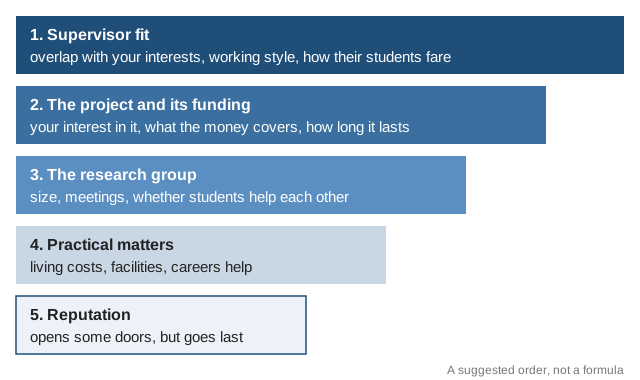
If you have more than one offer, or are deciding where to apply, it helps to weigh the factors in a rough order of importance:
The supervisor
Your supervisor is the biggest single factor. You will work closely with them for years, and their guidance, working style and support will shape the experience far more than the name of the institution. Before committing, find out whether their research overlaps with what you want to do, whether their students tend to finish, publish and move on to good positions, and whether they are hands-on or hands-off, and how that fits the way you work.
Some of this you can check yourself. Their recent publications show what they are working on now, and co-authors on those papers who are listed as students show whether students publish with them. Many group web pages list former members and where they went. If you have not yet been in touch, our guide on emailing a potential PhD supervisor covers the first message.
Current and former students are the best source for everything else. Most will give you a frank picture if you ask politely.
Questions to ask current students
A short call with one or two members of the group is worth more than any amount of reading. These questions tend to get useful answers:
- How often do you meet the supervisor, and how quickly do they reply to drafts?
- How much freedom do you have to shape your own project?
- How long do students in this group usually take to finish?
- Is the funding secure, and what happened when someone’s ran out?
- What do people do after they leave?
- Would you choose this group again?
Listen to how they answer as well as what they say. Hesitation over the last question tells you something.
The research group

The people around you also shape a PhD. A healthy group gives you collaborators, feedback and support when the work is going badly. Ask how big the group is, how often it meets and whether students help one another. Doing a doctorate in isolation is hard.
Small groups are not a problem in themselves; a group of three that meets weekly can be better than a group of twenty where students rarely see the supervisor. What matters is whether there is regular contact and someone to ask when you are stuck.
The project and its funding
Be clear about what the project involves and whether it interests you enough to carry you through years of work. Check what the funding covers, how long it lasts and what happens if the work runs over. A project that fits your interests and has secure funding is worth much more than a prestigious name attached to neither.
Get the funding terms in writing before you accept: the stipend, whether fees are included, the length of the award, and any teaching or other duties attached. Our PhD funding checklist lists what to look for, and the questions to ask before accepting template has space for the answers.
Practical matters
Some things are easy to overlook. You will be living in the place for years on a stipend, so the cost of living counts. The group needs the facilities and equipment your research calls for. And it is worth asking whether the department helps its students find their next post.
If you are moving country, add the visa conditions, whether a partner or family can come with you, and how far the stipend goes in that city.
Good signs and warning signs
Good signs
- Current students speak freely and would choose the group again
- Former students finished and moved on to jobs they wanted
- The supervisor answers your questions about expectations directly
- Funding terms are clear and written down
Warning signs
- Nobody in the group is willing to talk to you
- Several students have left without finishing
- The supervisor is about to move, retire or has very little time
- Vague answers about how long the funding lasts
One warning sign is not always a reason to turn a place down, but it is a reason to ask more questions.
Making the decision
Compare your options on supervisor fit, the group, the project, the funding and the practical side of living there. Get in touch with people who are already in each place; a short conversation will tell you more than a prospectus. Reputation does open some doors, so it is not irrelevant, but put it at the bottom of the list, because the day-to-day reality of a PhD depends on the person you work with and the environment around you.
If you are still deciding whether a doctorate is the right step, see Master’s or PhD?. If you are ready to look for places, finding a funded PhD explains where advertised projects are listed.