


Financial aid at Ashesi University
By Farouk Yahaya · Updated 5 October 2026

Ashesi University in Berekuso, just outside Accra, gives more financial aid than most private universities. Around half of the students on campus at any one time receive financial aid, and some of them are on packages that cover most or all of the cost. The university’s stated position is that no admitted student is turned away for financial reasons, and in practice the aid budget is set up to support that. The catch is admission itself, which is competitive, and the aid assessment that runs alongside it.
Why the aid model is unusual
Ashesi was founded in 2002 by Patrick Awuah, a Microsoft engineer who returned to Ghana intending to build a different kind of African university. It has a liberal arts core, strong engineering and computer science programmes, a written honour code and an emphasis on ethical leadership. Its published tuition is well above what Ghanaian public universities charge and comparable to the top private institutions on the continent. Against that, it has built up aid funding from donors, alumni and a few large foundation partners, the Mastercard Foundation most prominent among them.
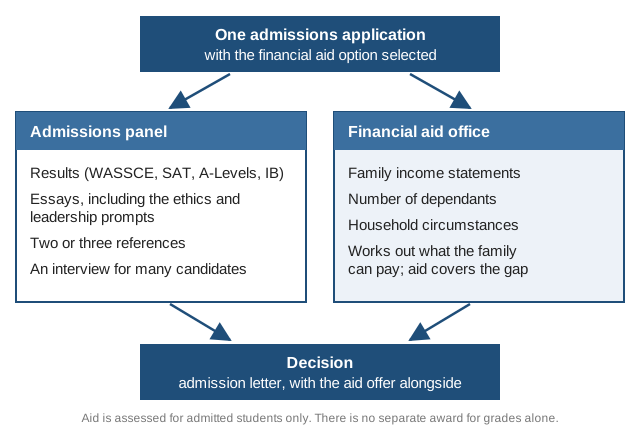
Aid is need-based. Merit comes into it only after the admission decision has been made, which reverses the way most scholarships elsewhere work, and there is no separate award you can win on grades alone. You apply for admission; if you are admitted, the financial aid office assesses what your family can pay and builds a package to cover the difference.
What a package contains
A package is usually made up of some combination of the following:
| Part of the package | What it is | Repaid? |
|---|---|---|
| Tuition grant | Reduces the published fee | No |
| Room and board grant | On-campus accommodation and meals, for students who cannot commute | No |
| Stipend | Small monthly cash allowance for textbooks, personal costs and travel home, for students with documented hardship | No |
| Work-study | Paid campus jobs in the library, IT support or departmental offices, fitted around classes | Earned |
| External donor scholarship | Named awards such as Mastercard Foundation Scholars, KEY Scholars and Salesforce Scholars, on top of or in place of the standard package | No |
| Loan | A smaller portion, sometimes set up as a deferred-repayment student loan, mostly for families who can pay something over time | Yes |
For a high-need student a package typically covers 70 to 100 per cent of total cost; for a middle-need student, 30 to 60 per cent. Families who can pay full tuition receive nothing. Aid is credited directly to the student’s account, and apart from stipends no cash changes hands.
Who can receive aid
The standard aid programme is open to Ghanaian and other African nationals admitted to undergraduate programmes who can show financial need, assessed from documented family income, dependants and household circumstances. There are no GPA, age or programme restrictions on aid once you are admitted. Continuing students have their aid reassessed each year, and it is generally renewed if they remain in good academic standing and the family’s situation has not improved.
Applicants from outside Africa can apply for admission but are not eligible for the standard aid programme. Some external scholarships, the Mastercard Foundation’s in particular, fund students from specific African countries to study at Ashesi.
What admissions look at
Because aid depends on admission, the admissions decision is the one to prepare for. Ashesi turns away more applicants than it admits. The panel weighs:
- academic results (WASSCE, SAT, A-Levels, IB or equivalent), with no fixed minimum but high expectations
- several personal essays, including Ashesi’s own prompts on ethics and leadership, which carry a lot of weight
- two or three letters of recommendation, from teachers and a community referee
- extracurricular activity and evidence of initiative, meaning what you did with the opportunities you had
- an interview, which many candidates are given before the final decision
- fit with the university’s values: the honour code, the leadership focus and the expectation of working across disciplines
The essays count for more here than at most Ghanaian universities, and they are the part of the application you have the most control over.
Application rounds
Ashesi runs two main admissions rounds each year for entry the following September:
| Round | Application window | Decision by |
|---|---|---|
| Early Action | September to November | January |
| Regular Decision | December to February | April |
In some years there is also a rolling round for late applicants, but places are scarce by then and aid is harder to secure because most of the year’s budget has been committed.
You hear back sooner, you have more time to discuss your aid offer, and more of the year's aid budget is still uncommitted. Current dates are on the official Ashesi admissions page.
There is no separate aid application. You indicate on the admissions form that you are applying for aid, and the financial aid office carries out its assessment alongside the admissions decision.
Ashesi does not publish acceptance rates. What its own materials indicate is that admission is selective, aid is widely available to those admitted, and the Mastercard Foundation Scholars track is considerably tighter than the main aid pool. For most applicants the harder bar is getting in.
Preparing the application
Give yourself time. The essays are demanding, recommenders need to be people who know you, and the financial documents take a while to collect. Six months before the Early Action deadline is a sensible starting point.
Ashesi publishes its essay prompts on the admissions site. Write a full draft of each as soon as they appear, leave them for a couple of weeks, then reread, cut the weakest parts and rewrite. Our guide to writing application essays covers most of the same principles.
Most Ghanaian applicants come in through the WASSCE, with strong results in core mathematics, English and the subject combination relevant to their intended programme. International applicants usually use the SAT, A-Levels or IB. Ashesi has at times been test-optional and at other times required tests, so check the policy for the current cycle.
For references, the usual pairing is a teacher in your strongest subject and a community referee who can speak to your character outside school. Tell them which programme you are applying to and what you would like them to emphasise. A specific letter from a teacher who knows you well, even in a less central subject, is more useful than a generic one from the head of school.
The portal opens in late August or early September. Have these ready before it does:
- Academic records: transcripts, WASSCE results, or predicted grades if you are still in school
- Identity documents: Ghana Card for Ghanaian applicants, a passport scan for others
- Two recommendation letters, submitted by your referees through the portal
- The application essays
- The financial aid disclosure: income statements, dependants, household circumstances
Be complete with the financial documents. The aid office cannot fill in gaps, and a missing document tends to be read in the least favourable way.
The interview
Shortlisted applicants are interviewed on campus, by video, or at a regional centre during international recruitment trips. Expect 30 to 45 minutes, mostly conversational, covering your motivations, what you read, why Ashesi in particular, and one or two situational questions on ethics and leadership. Anything listed on your application may come up, so list only activities you took part in. Our interview preparation sheet is a useful way to rehearse.
Responding to the aid offer
The aid offer comes with the decision letter or shortly after it. If the package leaves a gap your family cannot meet, you can write to the financial aid office and ask for a reassessment, with new documents if your circumstances have changed since you applied. The package is not always increased, but one polite request is reasonable.
Further sources
The official admissions site links to the financial aid page, which has current cost figures and descriptions of the aid on offer. Open days are announced on the site and on Ashesi’s social media, and attending one is a good way to understand the university before you apply. Ashesi also has an active alumni community, and a short call with a current student or graduate from your home region will tell you a good deal about how the application works in practice.
The Mastercard Foundation Scholars Program at Ashesi uses the same admissions process with an additional layer of aid; we cover the programme at two public universities in the Mastercard Foundation Scholars guide.