


Mastercard Foundation Scholars at KNUST and the University of Ghana
By Farouk Yahaya · Updated 5 October 2026
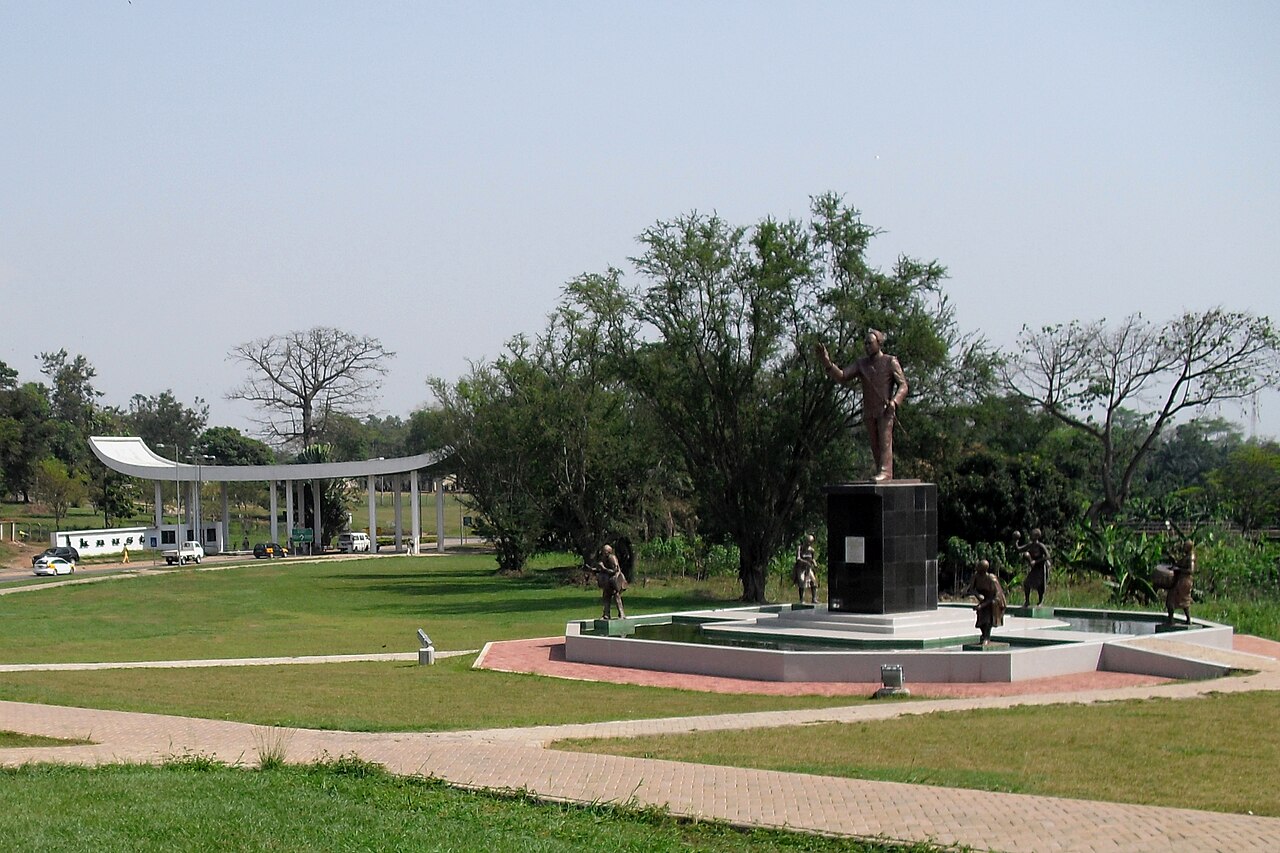
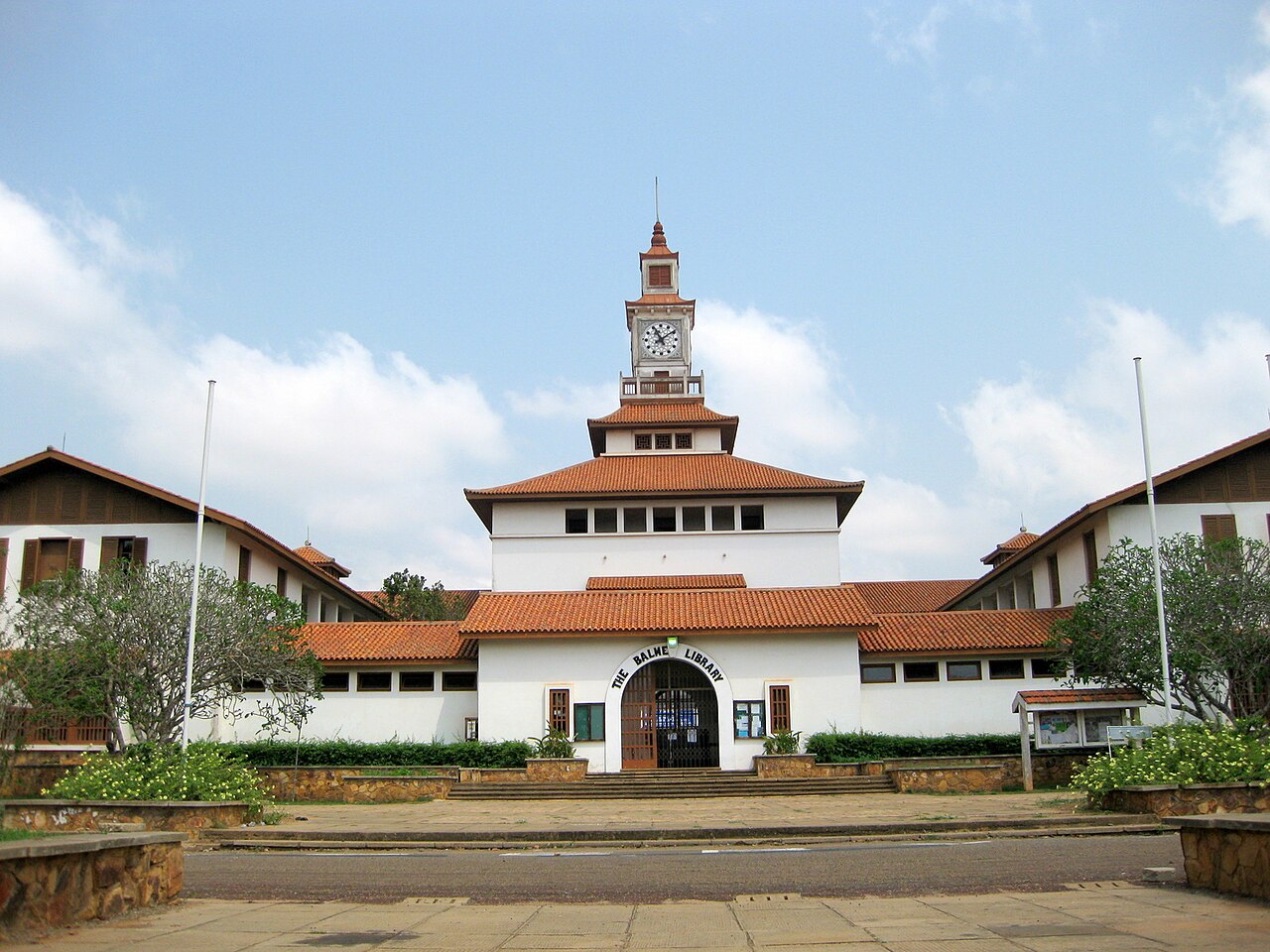
The Mastercard Foundation Scholars Program is the most generously funded scholarship at Ghana’s two largest public universities. It pays for a full undergraduate degree and all living costs, and adds mentoring, leadership training and support after graduation, for African students who could not otherwise afford university at this level. It has been running at KNUST and the University of Ghana for a number of years, and its alumni now work across the continent.
It is among the most competitive scholarships hosted in Ghana. This guide explains how the programme runs at each university, what the selectors look for and how the application is put together.
About the programme
The Mastercard Foundation launched the Scholars Program in 2012 to educate young Africans, most of them women, in fields and institutions that can drive economic and social change on the continent. It works through selected partner universities in Africa and elsewhere, and KNUST and the University of Ghana are two of its African partners.
Each university has a dedicated programme office and staff, and the scholars form a recognisable community within the campus. They meet regularly, attend leadership sessions, carry out community projects and have a structured route into internships and work after graduation. The programme wants its graduates to leave with leadership experience as well as a degree.
What the scholarship covers
At both KNUST and UG the package is complete:
- full tuition and academic fees for the length of the undergraduate programme
- accommodation on campus or an equivalent arrangement
- a monthly stipend for living costs
- books, a laptop and other academic supplies
- a yearly trip between the university and the scholar’s home country
- medical insurance through the university health service
- leadership workshops, retreats and networking events
- help with internships and job placement in the final years
- membership of the alumni network and continuing support after graduation
This is considerably more than most other Ghana-based scholarships offer. It is designed so that a scholar can arrive, study and graduate without paying anything themselves.
Eligibility
The programme is open to students from across Africa, not only Ghanaians. The list of eligible countries varies by university and by cycle. KNUST has taken students from across the continent, with sizeable numbers from Ghana, Nigeria, Kenya, Uganda, Rwanda, Ethiopia, Burkina Faso and other West and East African countries. The University of Ghana also takes a broad African intake and has sometimes reserved places for students from particular regions.
Selectors look at five things:
- Financial need. This is compulsory, since the programme exists for economically disadvantaged students, and you will have to document your family’s income and household circumstances.
- Academic results. Applicants need excellent WASSCE or equivalent results, and successful candidates are usually among the best in their year.
- Leadership and community involvement. Evidence that you are already doing something useful with what you have, whether a leadership role at school, community service or an extracurricular project.
- A commitment to Africa. Scholars are expected to work in their home country or elsewhere in Africa after graduating, and the programme treats this as a firm expectation.
- Age. There is usually a limit, typically under 25 at the start of the programme, though the exact cut-off varies by cycle.
The programme has an explicit gender target: at least 70 per cent of scholars across the global cohort are women, and KNUST and UG actively prioritise women applicants.
Programmes funded
Both universities fund a wide range of undergraduate degrees, with priority for fields linked to the continent’s development needs. These include STEM subjects (engineering, computer science, agriculture and the natural sciences), health (medicine, nursing, public health and pharmacy), social sciences and policy (economics, public administration and development studies), business (business administration, finance and entrepreneurship) and education for future teachers and education researchers. Humanities and liberal arts degrees are also eligible at both universities, though fewer scholars are taken on in them.
The annual cycle
The cycle runs once a year and is tied to the start of the Ghanaian academic year. Exact dates change, but the usual pattern is:
- February to MarchCycle announced on each university's Scholars Program page
- March to MayApplication window opens
- May to JulyApplication deadline
- June to AugustShortlisting and interviews
- August to SeptemberFinal decisions; compulsory cohort orientation, usually in August
- August to SeptemberScholars arrive for the start of the academic year
For KNUST, search “Mastercard Foundation Scholars KNUST” or go to the university’s scholars office page. At the University of Ghana the programme runs through the Office of International Programmes, and current notices appear on ug.edu.gh.
Neither university publishes acceptance figures for the programme, but applications run well beyond the number of places, and it is one of the hardest scholarships in Ghana to win.
Applying
1. Check that you qualify
Read the current cycle’s eligibility criteria before you do anything else. Applications that miss a stated requirement, whether age, nationality, programme or the financial need threshold, are screened out early.
2. Give yourself time
This application cannot be put together over a weekend. The forms are detailed, the essays are demanding and collecting the documents takes a while. Allow at least three months; the strongest applicants often start six months before the deadline.
3. Collect the documents
- a government-issued ID (Ghana Card for Ghanaian applicants, a passport for others)
- secondary school transcript and certificate, and WASSCE or equivalent results
- a current transcript if you are already at university
- two or three reference letters, at least one academic and ideally one about your leadership or community work
- evidence of family income, such as a parent’s payslips, an employer’s letter or a community attestation; families who are self-employed or in the informal sector can provide a notarised statement with supporting evidence
- evidence of leadership and community work: letters, certificates or photographs of activities
- passport photographs
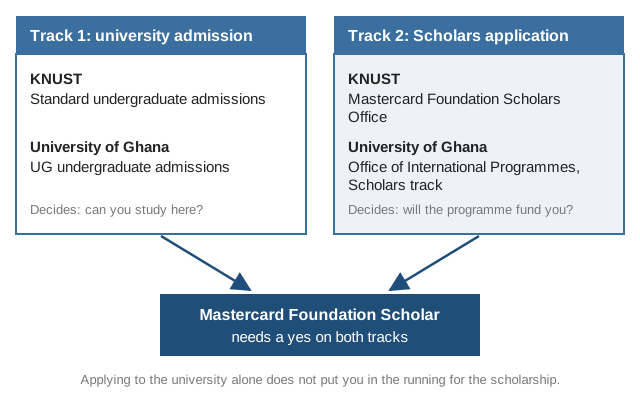
4. Apply through both tracks
This is the step many applicants miss. At KNUST and UG the Scholars Program is not a separate scholarship with its own stand-alone form; it runs through, or alongside, the normal university admissions process.
5. Write the essays
The application normally includes several essays covering motivation, leadership, community involvement and plans after graduation, and they carry a lot of weight. Good essays rest on particular moments and concrete examples. They name the problem in Africa the applicant wants to work on, show leadership through things the applicant has done, and set out a post-graduation plan that names countries, sectors and kinds of work.
Top grades alone are not enough; selectors tend to prefer rounded candidates to those whose only strength is their results. Modest examples described precisely (starting a club, running a community project, teaching Sunday school for three years) are more convincing than large claims, and any exaggeration of leadership or community work can cost you the place. The post-graduation plan counts for a great deal:
“I will return to my country and contribute.”
“I will join the public health unit at Ridge Hospital and focus on maternal health in the Greater Accra region.”
Our guide to writing a strong motivation letter applies directly here.
6. Prepare for the interview
Shortlisted candidates are interviewed, usually for 30 to 45 minutes by a panel of programme staff and academics. The conversation centres on your motivation, character and plans. Dress conservatively, arrive early and bring the originals of every document you uploaded. The panel reads the written application closely and may ask about anything in it.
7. Orientation
Successful applicants are invited to a cohort orientation, usually in August before the academic year starts. Attendance is compulsory.
Further information
- Mastercard Foundation Scholars Program: mastercardfdn.org/all/scholars, and our Mastercard Foundation funder page
- KNUST Mastercard Foundation Scholars Office: see knust.edu.gh for the current cycle notice and contact details
- University of Ghana Office of International Programmes: ug.edu.gh
- The alumni community is active, and a half-hour conversation with a recent graduate of the programme is one of the most useful things you can do to prepare.
The programme also runs at other partner universities, including the African Leadership University in Rwanda, Ashesi University in Ghana (see our Ashesi financial aid guide), the American University of Beirut and the University of Cape Town. Eligibility and procedures differ from one institution to another, so if you do not get a place at KNUST or UG, check the others as well.