


Chevening, DAAD EPOS and Erasmus Mundus compared
By Farouk Yahaya · Updated 5 October 2026

Chevening, DAAD EPOS and Erasmus Mundus are among the best-regarded fully funded routes to a Master’s for international students. Applicants often pursue all three in the same year, but they select for different profiles, run on different timetables and suit different plans, so it usually pays to decide which one deserves most of your effort.
Side by side
| Chevening | DAAD EPOS | Erasmus Mundus | |
|---|---|---|---|
| Where you study | United Kingdom | Germany | Two or more countries |
| Selects mainly on | Leadership and career plan | Professional relevance and academics | Fit with a specific joint programme |
| Work experience | At least two years after your undergraduate degree (2,800 hours) | At least two years of professional experience after your Bachelor’s | Not usually required |
| Academic record | An undergraduate degree that qualifies you for a UK Master’s | Results in the upper third; degree normally no more than six years old | A Bachelor’s degree, or be in the final year of one |
| One deadline? | Yes, one national round | Per programme | No, per programme |
| You apply to | Chevening plus 3 UK courses | The specific German course | Each consortium directly |
The rules change from cycle to cycle, so confirm the current details on each official site. The figures above come from the Chevening eligibility guidance, the DAAD scholarship database entry for EPOS and the European Commission’s Erasmus Mundus page, as checked in October 2026.
Chevening
Chevening is the UK Government’s scholarship, and it looks at leadership and career direction as closely as at grades. It suits applicants with a few years of work behind them, a clear account of the influence they have had, and a concrete plan for what they will do on returning home. An applicant with a strong academic record but little leadership history will usually find a course-based scholarship easier to make a case for.
The eligibility rules are firm. You need at least two years of work experience gained after your undergraduate degree, which Chevening defines as 2,800 hours. Full-time, part-time, voluntary work and internships can all count towards that total. You must also commit to returning to your home country for at least two years after the scholarship ends, so the plan you describe has to be a plan for home.
Administratively it is the simplest of the three, with a single national application window. You also have to apply to three different eligible UK Master’s courses and hold an unconditional offer from at least one of them by the stated deadline. Our Chevening funder page covers the essays and interview in more detail.
DAAD EPOS
EPOS (Development-Related Postgraduate Courses) funds professionals from developing countries to take specific development-focused Master’s programmes in Germany. It favours applicants with relevant work experience, at least two years after the Bachelor’s degree, who can show how the course connects to development work in their home country. DAAD also expects results well above average, in the upper third, and says degrees should normally be no more than six years old when you apply.
DAAD runs many programmes, and EPOS is only one of them. The most important step is identifying the exact EPOS-eligible course and applying to it by its own deadline; applying under the wrong DAAD programme is a common and avoidable error. Applications go to the course itself, not to a central DAAD office, and each course sets its own deadline.
At the time of writing, the DAAD database lists a monthly payment of 992 euros for graduate scholarship holders, plus allowances for insurance and travel. Amounts are revised from time to time, so check the current figure before you budget around it. More background is on our DAAD funder page.
Erasmus Mundus
Erasmus Mundus Joint Masters are taught by a consortium of universities in different countries, and each scholarship belongs to a particular programme, not a general pool. Selection turns on academic fit with that programme. Work experience is not usually required, which makes it a realistic option straight after an undergraduate degree; you can apply in the final year of your Bachelor’s as long as you graduate before the Master’s starts.

The drawback is logistics. You change country partway through the degree, with the visas and moves that involves. The European Commission’s rules require study periods in at least two countries, which must be different from the one you live in when you enrol. Programmes last one to two academic years.
Because there is no common deadline you apply to each consortium on its own timetable. The Commission’s page notes that applications typically run from October to January for courses starting the following academic year, but the programme’s own website gives the date that counts. Full scholarships contribute to travel, visa costs and a living allowance. Our Erasmus Mundus funder page explains how to search the catalogue of programmes.
Which to prioritise
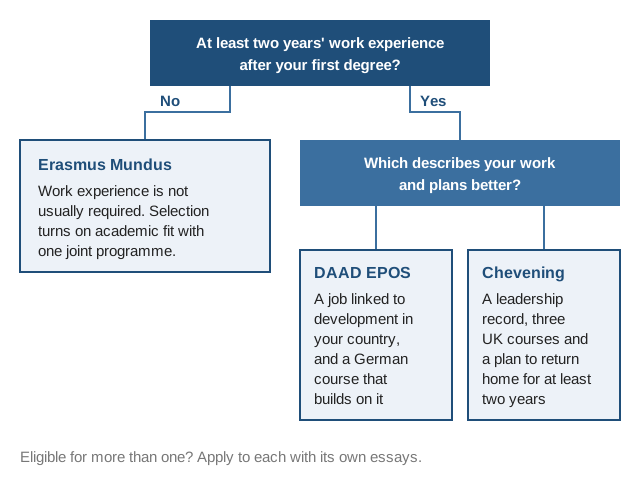
Chevening makes most sense if you have work experience, a clear leadership record and a specific plan to return home, and you want to study in the UK. DAAD EPOS fits someone working in a development-related field with a couple of years’ experience and a German course that lines up with their career. Erasmus Mundus suits a strong academic profile, an interest in studying in more than one country, and a tolerance for the extra administration.
If you fit two of the three, look at the course before the funder. A Master’s you would choose anyway, with a funder whose criteria you meet comfortably, makes for a stronger application than a famous award you can only just argue your way into.
Applying to more than one is allowed, but each needs its own essays written to its own criteria. Chevening wants leadership and a plan for home, EPOS wants a link between your job and development, and an Erasmus Mundus consortium wants to know why its particular programme. A single generic application sent to all three usually does worse than a focused application to the one that fits.
The timetables also overlap, which matters for planning. A Chevening application, an EPOS course application and two or three Erasmus Mundus applications can easily fall within the same few months, each with its own references and documents. Our guide to applying to many scholarships efficiently covers how to manage that load. Each provider publishes its own guidance, and the official source is the place to confirm the current deadline.