


Marie Skłodowska-Curie Doctoral Networks PhD positions 2027
Salaried three-year PhD positions in EU-funded research networks across Europe, open to any nationality

- Funder
- European Commission (Marie Skłodowska-Curie Actions)
- Study in
- Several countries
- Level
- PhD
- Funding
- Full
- Closes
- Varies by country or course There is no single deadline. Each network advertises its own positions on EURAXESS and sets its own closing date, and new vacancies appear throughout the year. The date shown is one open example: the FlexCAT network's 15 positions close on 31 October 2026.
- Official site
- marie-sklodowska-curie-actions.ec.europa.eu
Checked on marie-sklodowska-curie-actions.ec.europa.eu by Farouk Yahaya, 9 October 2026. Scholarly Dream is independent and not affiliated with this funder.
Marie Skłodowska-Curie Actions (MSCA) are the European Union’s main fund for researcher training. Under its Doctoral Networks scheme, a group of universities, research institutes and companies in several countries wins a grant together and uses it to hire a cohort of doctoral candidates, each on a separate project within the network’s theme. Those candidates are employees on contracts, with a salary set by EU rules, and they are recruited from anywhere in the world.
This makes the scheme different from most scholarships on this site. Nobody applies to “the Marie Curie programme”. You find a network that has advertised positions, check the rules for the one you want and apply to the network or host institution directly. The European Commission page says the list of funded vacancies on EURAXESS, the EU’s research jobs portal, is updated daily (checked 9 October 2026 on the official Doctoral Networks page).
Three kinds of network
- Standard Doctoral Networks train candidates in a shared research area, with secondments to other partners for part of the time.
- Industrial Doctorates place candidates outside academia for at least half their contract, usually at a company.
- Joint Doctorates lead to a joint, double or multiple degree from two or more universities, and positions can last up to 48 months.
Individual positions in standard networks run for 3 to 36 months, and most advertised posts are full-time three-year contracts.
What the EU pays per candidate
The European Commission sets the funding per researcher in its MSCA work programme. The figures below come from the 2026 to 2027 work programme and the Commission’s note on unit costs, both checked on 9 October 2026.
| Allowance | Monthly amount | Notes |
|---|---|---|
| Living allowance | €4,250 in networks funded from the 2026 call; €4,010 in networks from the 2024 and 2025 calls | Gross figure before employer and employee social security and tax, adjusted by a country coefficient |
| Mobility allowance | €710 | For private costs of moving, such as travel and accommodation |
| Family allowance | €660 | Paid if you have a spouse, recognised partner or dependent children |
| Long-term leave and special needs | Where applicable | For parental leave and for researchers with disabilities |
Most positions open now belong to networks funded from the 2024 and 2025 calls, so their offers will usually be based on €4,010. The country coefficient changes the living allowance a lot. It is 101.5% for Germany, 131.3% for Denmark and 70% for Bulgaria, for example. Because the living allowance is gross, your take-home pay depends on the host country’s tax and social security rules, and the Commission asks hosts to publish the gross salary in the vacancy notice where possible. Hosts may add a top-up but cannot pay less.
The work programme requires hosts to employ candidates on a contract with full social security cover, including sickness, parental and unemployment benefits and pension rights. Only in rare cases where national rules prevent a contract can a host offer a fixed-amount fellowship instead, and the living allowance is then halved. If a vacancy mentions a fellowship rather than a contract, ask why.

Who can apply
The work programme’s rules for recruited researchers are short:
- Any nationality. There is no list of eligible countries.
- No doctorate. You must not hold a doctoral degree on the date you are recruited. If you have defended a thesis but not yet received the degree, you are also ineligible.
- Enrolment. You must be enrolled in a doctoral programme leading to a degree in at least one EU member state or Horizon Europe associated country. The host arranges this with you.
- Mobility. The rule explained below.
Each position then adds its own requirements, usually a Master’s in a relevant subject or a degree that gives access to doctoral study in that country, plus English. Read the full vacancy notice before you write anything, because these vary from network to network.
The mobility rule
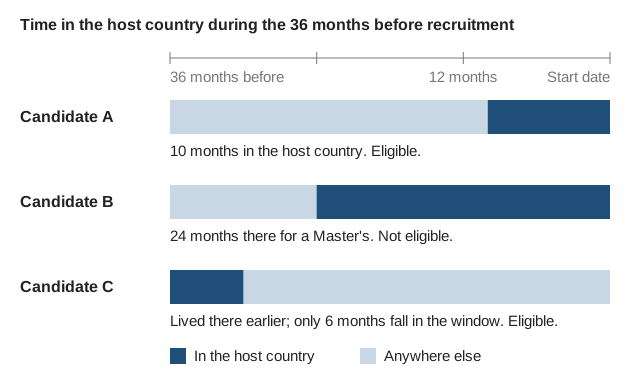
You must not have lived in, or carried out your main activity (work, study and so on) in, the country of the recruiting organisation for more than 12 months in the 36 months immediately before your recruitment date. The test is about the host country of that particular position, so one network can have posts you qualify for and posts you do not.
Some time does not count towards the 12 months: compulsory national service, short stays such as holidays, time spent going through a refugee status procedure under the Geneva Convention, and time spent obtaining EU temporary protection. People who already hold refugee status or EU temporary protection on their recruitment date are exempt from the rule altogether. If you are close to the limit, count the months carefully against your likely start date and ask the recruiter to confirm before you apply.
Finding and applying for positions
Recruitment follows each network’s own process, but the pattern is similar. A network usually advertises all its positions at once, with a single closing date. You submit a CV, a motivation letter, transcripts and references, sometimes ranking up to three positions within the network. Shortlisted candidates are interviewed, often online, before offers are made.
Do
- Search EURAXESS for "MSCA" or "Doctoral Network" and set up alerts in your field
- Check the mobility rule for each position's host country before you write a letter
- Write a separate motivation letter for each project, naming its methods and partners
- Look at secondment plans, since they decide where you will spend months of the contract
Don't
- Send one general letter to every position in a network
- Assume a Master's from the host country is an advantage; it may make you ineligible
- Pay an agent to apply for you; you apply directly to the network or host
As an example of what is open now, the FlexCAT network on disordered protein regions is hiring 15 doctoral candidates across Austria, Germany, the Netherlands, Israel, Italy, the United Kingdom and Luxembourg, with applications closing on 31 October 2026. Plenty of others will appear in the coming months.
When new positions appear
Networks are funded in yearly calls. The 2026 call for consortia closes on 24 November 2026, and the 2027 call on 23 November 2027. The Commission expects to announce results of the 2026 call in April 2027, with the first new networks starting in September 2027, and both dates are marked as provisional. Those networks will advertise their positions over the following months. In practice, vacancies are posted all year round, so the best approach is a standing alert rather than waiting for one season.
Each position has a fixed project, supervisor and host. A strong application shows that you fit that project, with evidence of the skills the vacancy lists. Our guide to finding and applying for a funded PhD covers how project-based applications differ from proposal-based ones.
Before applying, it also helps to have an academic CV ready to adapt, since networks often ask for one in a set format. For the rules on eligibility, and to look for vacancies, use the official MSCA Doctoral Networks page and the EURAXESS jobs portal it links to.