


Stipendium Hungaricum Bachelor's Scholarships 2027/28
Free tuition, a monthly stipend, housing support and medical cover for a bachelor's degree at a Hungarian university, for citizens of partner countries

- Funder
- Government of Hungary, run by Tempus Public Foundation
- Study in
- Hungary
- Level
- Undergraduate
- Funding
- Partial
- Closes
- Next round not yet announced The 2026/27 round closed at 14:00 CET on 15 January 2026. The call for 2027/28 had not been published on 9 October 2026. Your sending partner may set an earlier deadline of its own.
- Official site
- stipendiumhungaricum.hu
Checked on stipendiumhungaricum.hu by Farouk Yahaya, 9 October 2026. Scholarly Dream is independent and not affiliated with this funder.
Stipendium Hungaricum is the Hungarian government’s scholarship for international students, launched in 2013, managed by the Ministry of Foreign Affairs and Trade and run day to day by Tempus Public Foundation. It works through bilateral education agreements with the governments of partner countries, which the programme calls sending partners. For bachelor’s study it waives tuition fees and adds a monthly stipend, housing support and medical cover for the full length of the degree, which runs two to four years. Around 30 universities and colleges took part in the 2026/27 round, with about 900 programmes in foreign languages across all levels.
The 2026/27 round closed at 14:00 CET on 15 January 2026. On 9 October 2026 the call for 2027/28 had not yet appeared on the official application page. The previous call was published in October 2025, so keep checking the page through the autumn, and contact your sending partner now, since it may ask for documents or set a deadline before Tempus does.
What the scholarship covers
| Item | Bachelor’s level, 2026/27 call (checked 9 October 2026) |
|---|---|
| Tuition | Full exemption from tuition fees |
| Monthly stipend | HUF 43,700 a month, twelve months a year, until you finish |
| Housing | A free dormitory place where the university has room, or HUF 40,000 a month towards rent |
| Medical cover | Hungarian state health care, where the bilateral agreement allows it, plus supplementary insurance of up to HUF 65,000 a year |
| Hungarian language | A compulsory course in Hungarian as a foreign language, free of charge |
The call puts the stipend at roughly EUR 110 and the housing contribution at roughly EUR 100 a month, and is plain that these amounts do not cover all living costs. It notes that HUF 40,000 will not pay a full rent in larger cities, Budapest above all, and asks applicants to work out their own budget before applying. There is no flight allowance.

Who is eligible
You must be a citizen of a sending partner country and apply through that country; a Nigerian citizen living in Ghana, for example, applies through Nigeria. The 2026/27 list of partners for full degree study ran to more than 90 countries and territories across Africa, Asia, Latin America, the Middle East and eastern Europe, among them Ghana, Kenya, Nigeria, Ethiopia, India, Pakistan, Indonesia, Brazil, Mexico and Vietnam. Not every partner sends students to every field, so check the study areas listed for your country on the partners page.
You can apply if
- You hold the citizenship of the sending partner you apply through
- You will be at least 18 by 31 August of your start year (dance applicants excepted)
- You are in your final school year, as long as you upload your certificate by 1 August
- You meet the entry and language requirements of the programmes you choose
You cannot apply if
- You hold Hungarian citizenship, including as a dual citizen
- You are stateless, a refugee or asylum seeker, or a long-term resident of Hungary
- You are applying for a doctorate through the programme in the same round
- You submit more than one application, or apply through more than one sending partner
Former scholarship holders and self-financed students already in Hungary face further restrictions. A self-financed bachelor’s student, for instance, can only apply for a scholarship at the same level with a recommendation from their university and above-average results. You do not need an admission offer before applying, and you do not need a passport yet: a national identity card and a signed declaration will do, with the passport uploaded by 1 August.
How selection works
There are three gates, and each is run by a different body.
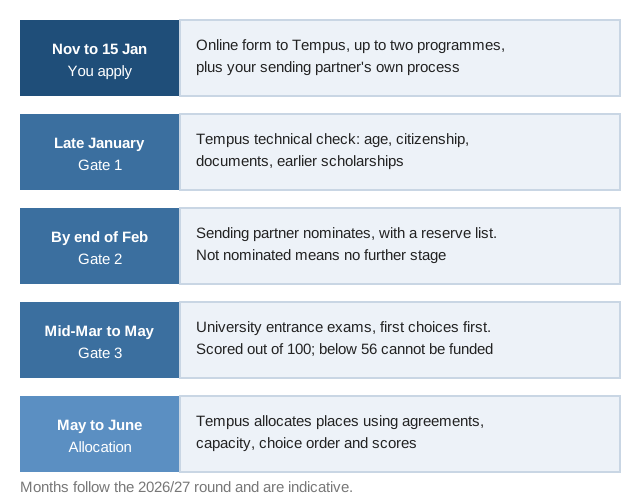
After the technical check, your application goes to your sending partner, which ranks candidates by its own method and sends Tempus a nomination list and a reserve list. Nominated applicants pass to the universities, which check documents and then examine candidates. The date and format of each exam are set by the university, so one may ask for an online test and another for an interview. Scores are out of 100, and the call states that no one scoring below 56 receives an offer.
Tempus then allocates scholarships using the bilateral agreement with your country, the capacity of each programme, your order of preference, your exam result and your sending partner’s ranking. Applicants in STEM fields, which here include health and agricultural sciences, get priority, and the number of students from one country may be capped on crowded programmes such as medicine. In the 2026/27 call Tempus reported 80,000 applications and more than 4,500 awards in 2025, across all levels.
You may list up to two programmes, at the same university or different ones, and the order is locked at the deadline along with the study mode and language. Universities examine first-choice applicants from mid-March to the end of April and second choices afterwards, until about 20 May. Many full-degree programmes also appear as partial (exchange) programmes in the system, so check the study mode before you submit.
Studying in Hungarian, or not
Most scholarship holders take English-taught degrees. If you choose a Hungarian-taught programme without B2 Hungarian, you apply for the one-year Hungarian preparatory course instead, and you must then continue in Hungarian; switching to English afterwards is not allowed. Everyone else takes the compulsory Hungarian as a foreign language course in the first year. Skipping it stops the stipend, and failing its exam at the end of the second semester cuts the stipend to HUF 30,000 a month.
For engineering, music, dance, computer science and IT, the university may decide during the entrance exam that you need a foundation semester or year in English before the degree begins. You cannot apply for that year directly.

Documents and submission
Everything goes through the online system at apply.stipendiumhungaricum.hu, in English, with files of up to 4 MB each. Bachelor’s applicants need:
- The completed online form with a photo taken in the last two years.
- A motivation letter of at least one page, in Times New Roman 12 point, written in the language of the programme.
- Proof of language proficiency at the level your university sets.
- Your secondary school certificate and transcript, with translations if they are not in the programme’s language.
- A copy of your passport data page, or your national identity card if you have no passport yet.
- Acceptance of the online Statement for Application.
Art and music applicants add a portfolio. A medical certificate is needed only after an award, and you bring it to Hungary rather than uploading it. Apply to your sending partner in parallel; its contact details are on the programme website. The programme says there are no application costs and advises against using agents.
Our guide to writing a motivation letter helps with the one-page letter, and the deadline planner can hold the January date once the new call sets it. Confirm every figure in the 2027/28 call on the official site once it is published.