


DAAD EPOS Development-Related Postgraduate Courses 2027/28
A DAAD scholarship for professionals from developing countries to take a development-related Master's at a German university

- Funder
 Deutscher Akademischer Austauschdienst (DAAD)
- Study in
- Germany
- Level
- Master's
- Funding
- Full
- Closes
- Varies by country or course Each course sets its own scholarship deadline for the 2027/28 intake, mostly in the autumn of 2026. Heidelberg's MSc International Health closes on 15 October 2026, TH Köln's NRM, IWRM and REM courses on 17 October, TU Dresden's Tropical Forestry on 30 October, and TH Köln's IWRM course run with the German Jordanian University on 15 November. Check the website of each course you choose.
- Official site
- www2.daad.de
Checked on www2.daad.de by Farouk Yahaya, 12 October 2026. Scholarly Dream is independent and not affiliated with this funder.
EPOS is the German shorthand for DAAD’s development-related postgraduate courses. Under it, DAAD pays scholarships for professionals from developing and newly industrialised countries to take a Master’s, and in exceptional cases a doctorate, at a German university. The scholarship is tied to a fixed list of courses chosen for their relevance to development, in fields from forestry and water management to public health and education. DAAD says funding depends on money from Germany’s development ministry (BMZ).
The 2027/28 intake is open now, with courses starting in 2027. There is no single closing date: each course runs its own window, and several close in October 2026 (checked 12 October 2026 on the DAAD database entry and the course websites linked below).
You choose from a fixed list of courses
The scholarship only funds courses on DAAD’s current list for the 2027/28 intake. A Master’s that is not on it cannot be funded through EPOS, however development-minded it is, and you cannot use EPOS for a programme you have already started in Germany. Most listed courses are taught in English and last 12 to 24 months.
| Field | Examples from the 2027/28 list |
|---|---|
| Economics and management | Development Economics (Göttingen), Small Enterprise Promotion and Training (Leipzig), Development Management (Bochum) |
| Engineering | Hydro Science and Engineering (TU Dresden), Sustainable Energy and Development (Flensburg), Sustainable Renewable Energy Technologies (Oldenburg) |
| Urban and regional planning | Urban Management (TU Berlin), Integrated Urbanism and Sustainable Design (Stuttgart with Ain Shams University) |
| Agriculture, forestry and environment | Tropical Forestry (TU Dresden), Agricultural Economics (Hohenheim), Environmental Governance (Freiburg), Natural Resources Management and Development (TH Köln) |
| Public health | International Health (Charité Berlin; Heidelberg) |
| Education | International Education Management (Ludwigsburg with Helwan University, Cairo) |
The table is a selection, not the full list. DAAD publishes the complete list as a PDF linked from daad.de/epos. A few courses take a new cohort only every second year: Development Management at Bochum, for example, is marked with its next intake in 2028. One course, Textile Machinery and High Performance Material Technology at TU Dresden, is taught in German.
What the scholarship pays
| Item | Detail (DAAD database, checked 12 October 2026) |
|---|---|
| Monthly payment, Master’s | EUR 992 |
| Monthly payment, doctoral candidates | EUR 1,400 (from February 2026) |
| Insurance | Payments towards health, accident and personal liability cover |
| Travel | A travel allowance, unless your home country or another funder covers it |
| Possible extras | A monthly rent subsidy and an allowance for accompanying family members, in some circumstances |
| German-taught courses | A preparatory German course in Germany of up to six months |
Funding runs for 12 to 42 months depending on the course; the longer end applies to the rare doctoral places. DAAD’s list of benefits does not mention university fees, so ask each course whether it charges any and who pays them for scholarship holders.

Who the scholarship is for
DAAD describes its typical scholarship holder in some detail, and the description works as a checklist. You are likely to fit if you:
- Work for a government body or a state or private company in a developing country, on projects with a development purpose
- Hold a Bachelor's in a related subject, normally a four-year degree, with results in the upper third
- Have at least two years of related work since that degree, counted at the date you apply
- Finished your most recent degree normally no more than six years ago
- Live in and apply from a country on DAAD's EPOS list, which covers most of Africa, Latin America, the Caribbean, the Pacific and much of Asia
- Have not lived in Germany for more than 15 months by the application deadline
Language is the other gate. English-taught courses want IELTS or TOEFL at the level the course sets. For a German-taught course you need at least B1 German, shown on a current certificate, when you apply; the six-month course in Germany then prepares you for the DSH 2 or TestDaF 4 needed to enrol. DAAD says passing is not possible without at least B1 beforehand, even after the intensive course.
Applicants from China also need an APS certificate from the German embassy’s academic evaluation centre.
How selection works
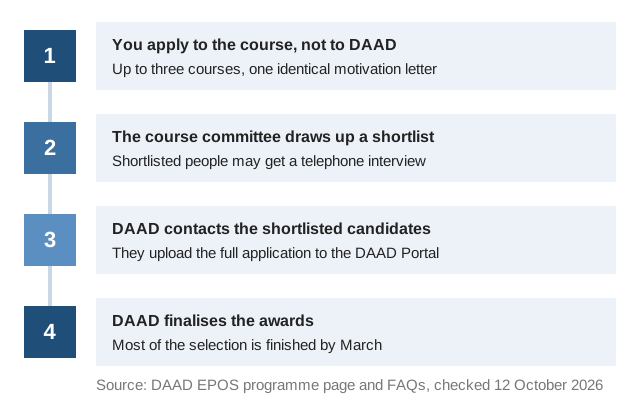
The first decision is made by a committee at the course. It reads the applications it receives and suggests candidates for a DAAD scholarship; DAAD’s FAQ says shortlisted applicants may get a telephone interview with university staff. DAAD then writes to the people suggested and asks them to upload the same documents as PDFs to the DAAD Portal, so keep a digital copy of everything you send. The final decision is DAAD’s. Its FAQ puts the end of most selection in March, and Heidelberg’s international health course tells applicants to expect an answer by February.
You will usually also need a place on the course itself. DAAD says admission is required before the scholarship can be paid, but you do not need a place before you apply for the scholarship.
Deadlines for the 2027/28 intake
Every course publishes its own window, and DAAD’s deadline list refers you to the course websites. A few examples, checked on 12 October 2026:
- 15 October 2026MSc International Health, Heidelberg (window opened 15 August)
- 17 October 2026NRM, IWRM and REM at TH Köln, through the university's online portal (window opened 17 September)
- 30 October 2026MSc Tropical Forestry, TU Dresden (window opened 1 September)
- 15 November 2026IWRM run by TH Köln with the German Jordanian University (window opened 1 September)
Late and incomplete applications are not considered at any of these, and DAAD’s FAQ is blunt that a missed course deadline cannot be rescued. Some universities, such as Flensburg, add a note that the scholarship depends on DAAD approving the funds.
What goes in the file
DAAD sets a list of documents and an order for them. The course may add its own requirements; TH Köln, for instance, also asks for a two-page research idea.
- The signed DAAD checklist and the EPOS application form
- A CV in reverse date order with no unexplained gaps, on the Europass template
- One motivation letter covering your academic, professional and personal reasons
- A recommendation letter from your current employer, dated, signed, stamped and on letterhead
- Employment certificates showing two years of relevant work since your Bachelor’s, ideally with a promise to re-employ you on your return
- IELTS or TOEFL, or a German certificate for German-taught courses
- Degree certificates and full transcripts, with certified translations if they are not in English or German and an explanation of the grading scale
Everything must be in English or German.
You can apply to as many as three listed courses, but each receives the same motivation letter. That letter has to explain why you chose these particular courses and why in that order, and the order must match the priorities on your DAAD form. DAAD says an application that ignores this may not be considered, and an award already made can be withdrawn.
How to apply
- Read the EPOS entry in the DAAD scholarship database and download the current course list from daad.de/epos.
- Choose up to three courses and open each course’s own website for its deadline, portal and any extra documents.
- Ask your employer for the recommendation letter and employment certificate early; stamps and signatures take time.
- Send the full application to each course by its deadline. Do not send it to DAAD.
- If a course suggests you for a scholarship, upload the same file to the DAAD Portal when DAAD writes to you.
Stipends, deadlines and the course list change between rounds. Confirm the details on the DAAD and course websites before you apply. If your work experience is shorter than two years, DAAD’s Study Scholarships for graduates cover a different set of countries, and our guide to choosing the right Master’s programme may help with the shortlist.