


Rotary Peace Fellowship 2028-29
A funded master's or one-year professional certificate in peace and development at one of eight university peace centres

- Funder
 The Rotary Foundation (Rotary International)
- Study in
- Several countries
- Level
- Master's
- Funding
- Full
- Closes
- 15 May 2027 The 2027-28 round is closed. Rotary says the 2028-29 application goes online in February 2027, and its stated window for applications runs from February to 15 May. Confirm the exact closing date when the form opens.
- Official site
- rotary.org
Checked on rotary.org by Farouk Yahaya, 8 October 2026. Scholarly Dream is independent and not affiliated with this funder.
The Rotary Peace Fellowship pays for people working in peace and development to spend time at one of eight university peace centres run with The Rotary Foundation. There are two tracks. The master’s track funds a degree of 15 to 24 months at one of five universities. The certificate track is a one-year professional programme, partly online, at one of three universities in Africa, the Middle East and Asia. Rotary offers up to 50 master’s places and up to 120 certificate places a year.
The 2027-28 application closed in May 2026. Rotary says the 2028-29 application will go online in February 2027, and its application page gives the submission window as February to 15 May (checked 8 October 2026 on rotary.org). That leaves about seven months to sort out transcripts, an English test and recommendations before the form opens.
The two tracks side by side
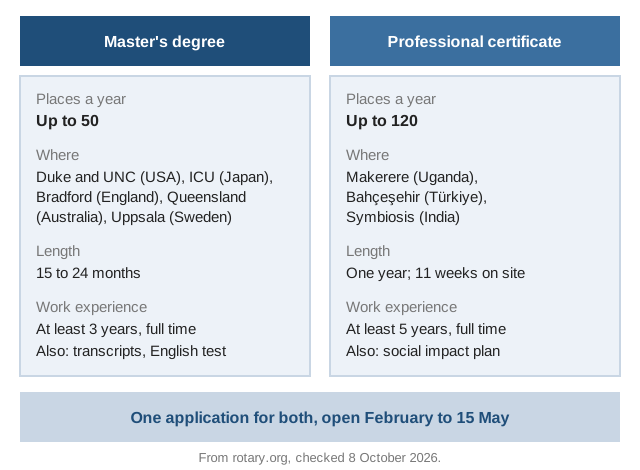
The master’s track suits someone a few years into a career who wants a full degree and time to research. You design a two to three month field placement yourself, take part in a professional workshop series and present your research at a final seminar. If you qualify for more than one centre, the form asks you to rank your top two.
The certificate track is for mid-career professionals who will keep their jobs. It opens with a two-week online course, moves to ten weeks on site with field studies, then runs for nine months while you carry out a social change initiative of your own design, with online sessions along the way. It closes with a one-week seminar on site that overlaps with the next cohort’s arrival.
What the fellowship covers
| Item | Covered (checked 8 October 2026) |
|---|---|
| Tuition and fees | Yes |
| Room and board | Yes |
| Travel | Round-trip transport to the peace centre |
| Field work | Internship and field-study expenses |
Rotary does not publish a cash stipend figure on these pages. The funding is described in terms of what it covers, so if you have dependants or ongoing costs at home, ask the centre what the fellowship pays out in cash before you accept.
The eight peace centres
Master’s degree centres
- Duke University and the University of North Carolina at Chapel Hill, USA. Fellows take a master’s in international development policy at Duke or a master’s in one of several UNC departments. Both can add UNC’s graduate certificate in international peace and conflict transformation.
- International Christian University, Tokyo, Japan. A master’s in peace studies within the public policy and social research programme.
- University of Bradford, England. A master’s in one of several subjects from the Department of Peace Studies and International Development.
- University of Queensland, Brisbane, Australia. A master’s in peace and conflict studies in the School of Political Science and International Studies.
- Uppsala University, Sweden. A master’s in social science focused on peace and conflict, from the Department of Peace and Conflict Research.
You cannot take the master’s at a centre in your own home country. A Swedish applicant cannot go to Uppsala, for example, but could go to Bradford or Tokyo.

Certificate centres
Each certificate centre has a regional focus, and you need a real connection to that region or a convincing reason to study its approaches to peacebuilding:
- Makerere University, Kampala, Uganda: Africa.
- Bahçeşehir University, Istanbul, Türkiye: the Middle East and North Africa.
- Symbiosis International University, Pune, India: Asia.
Coming from the region is one route in. Having worked there, or working elsewhere with communities from the region, also counts.
Who can apply
Both tracks need a bachelor’s degree, English good enough for graduate study, a record of commitment to peace and cross-cultural understanding, and signs of leadership. Then the requirements split.
- Master's: at least three years of full-time relevant work in peace or development
- Certificate: at least five years of full-time relevant work, and a plan for a social change initiative in the centre's region
- At least three years between finishing your most recent degree, undergraduate or graduate, and the fellowship's start date
- Not enrolled in a degree programme now, and not planning to be in the coming academic year
- Not using the fellowship for a doctorate, which it does not fund
- If you have already held a Rotary peace fellowship or a Rotary Global Grant Scholarship, at least three years since it ended
Rotary publishes a relevant experience guide on its application page. Use it to check whether your work counts before you start, since “relevant” is judged by Rotary and not by your job title.
The Rotary connection rules
Active Rotary members cannot apply, and nor can employees of a Rotary club, district or Rotary International. The exclusion also covers spouses, children, grandchildren (and their spouses), parents and grandparents of those people, and of former members who left within the last 36 months. Rotaract members who are not also Rotary members are eligible.
This is different from the support Rotary does want you to seek. A recommendation from a local Rotary club or district is optional but strongly encouraged, and many districts have a peace fellowship contact who can advise applicants. Being mentored by a club is fine. Being married to one of its members is not.
How selection runs
- Feb 2027The 2028-29 application opens online on Rotary's peace fellowship application page.
- By 15 MaySubmit. Recommendations, including any from a Rotary club or district, must be entered before you press submit, and the application cannot be changed afterwards.
- After MayApplications are screened against the eligibility rules. Those that qualify go on to full review.
- ReviewThe Rotary Peace Centers Committee, made up of Rotary members, reviews the top candidates with university representatives and chooses finalists. Some universities interview their top candidates.
- NovemberSelected candidates are told which peace centre they will attend.
- After NovemberYou apply for admission to the host university. A fellowship is not an offer of a place.
Reviewers look at English proficiency, commitment to peace and development, leadership potential, fit with Rotary and the fellowship’s aims, and your academic record against your preferred programme. For the certificate they also judge how feasible your social change initiative is and what difference it would make.

What to prepare before February
The form asks for a CV, academic or professional recommendations, essays and a personal statement video for both tracks. The master’s track also needs transcripts from every university you attended and an English test score, and Rotary names IELTS and TOEFL. The certificate track needs a social impact plan instead. Everything must be in English.
Transcripts and test bookings are the slow parts, which is why it makes sense to start them in the autumn. Rotary also publishes a reference sheet on English scores and exemptions, worth reading before you pay for a test you may not need.
Rotary asks for original content drawn from your own experience. It says the use of generative AI is highly discouraged and that plagiarism disqualifies an application. Generic phrasing is easy to spot, so write about specific work you have done, with names of places and programmes.
Use the next few months to find your nearest Rotary or Rotaract club through Rotary’s club finder. A conversation with a district peace fellowship contact, or with a past fellow they can introduce you to, will tell you more about how your experience reads than any guide. Then check the official peace fellowship page in February for the confirmed closing date.