


Swiss Government Excellence Scholarships 2027-28
A monthly stipend, health insurance and travel for a PhD or a one-year research stay at a Swiss university, for early-career researchers from 183 countries

- Funder
- Swiss Confederation, Federal Commission for Scholarships for Foreign Students (FCS)
- Study in
- Switzerland
- Level
- PhD
- Funding
- Partial
- Closes
- Varies by country or course Each country has its own deadline, at 23:59 Swiss time, between 6 October and 30 November 2026. 10 November is the most common date; 27 and 30 November are also frequent. Some countries, including the USA, Hungary, Iceland and Tunisia, have already closed. Check your country on the official list.
- Official site
- sbfi.admin.ch
Checked on sbfi.admin.ch by Farouk Yahaya, 9 October 2026. Scholarly Dream is independent and not affiliated with this funder.
The Swiss Government Excellence Scholarships are the Swiss Confederation’s awards for foreign researchers. A federal body, the Federal Commission for Scholarships for Foreign Students (FCS, or ESKAS in German), chooses the scholars, and the State Secretariat for Education, Research and Innovation runs the programme. The 2027-28 round is open to applicants from 183 countries and territories.
There are two research routes. A PhD scholarship funds doctoral study in Switzerland for 12 months at a time, renewable twice to a maximum of 36 months. A research fellowship funds a stay of up to 12 months for someone doing research within a PhD, for example a doctoral student registered at home. There is also an arts scholarship for a first Master’s in music or art, offered to a smaller set of countries. The FCS has stopped offering postdoctoral scholarships from 2027-28.
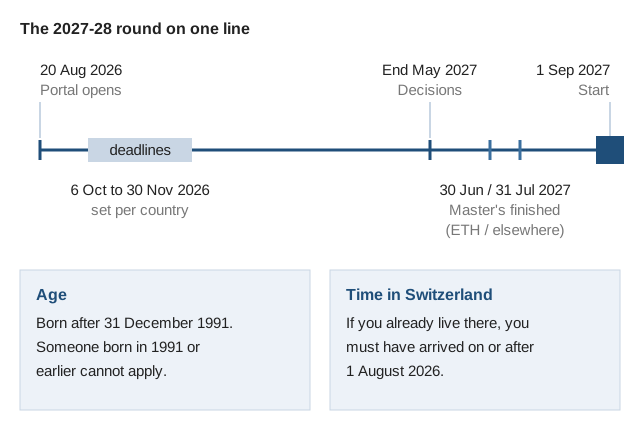
Applications opened on 20 August 2026. Deadlines are set country by country, and the latest fall on 30 November 2026 (checked 9 October 2026 on the official programme page). Scholarships start on 1 September 2027.
What the scholarship covers
| Item | Detail (checked 9 October 2026) |
|---|---|
| Monthly stipend | CHF 2,450, for one person’s basic living costs |
| Health insurance | Compulsory premiums paid for scholars from outside the EU and EFTA |
| Flight | A return flight allowance for scholars from outside the EU and EFTA |
| Housing | A one-off CHF 600 towards a rental deposit |
| Travel in Switzerland | A Half-Fare Travelcard for Swiss public transport |
| Activities | Excursions and events organised for scholars |
The rise to CHF 2,450 a month took effect in January 2026, and the FCS says it is reducing the number of scholarships to keep its total budget the same.
Some costs are not covered. Tuition and semester fees, which the programme page puts at CHF 600 to 2,000 a semester at some institutions, are your responsibility, as are conferences and fieldwork. There are no family allowances, and residence permits for accompanying family are restricted. The stipend is not a salary, so it suits a single person living modestly better than someone supporting a household. The study cost calculator gives a sense of what that means in practice.
Who can apply
- A Master's degree or equivalent, completed by 31 July 2027, or by 30 June 2027 if you are going to ETH Zurich
- Born after 31 December 1991
- A supervisor at a Swiss university, university of applied sciences, ETH Zurich, EPFL or one of the ETH Domain research institutes, who is a professor or lab group leader and, for a PhD, entitled to supervise doctoral theses
- A detailed research plan with milestones and a timeline
- Not in Switzerland for more than 13 months before the start date; if you already live there, you arrived on or after 1 August 2026
- Never held a Swiss Government Excellence Scholarship before, and not already turned down three times
Priority goes to people who have not studied or done research in Switzerland before. Doctoral students on a cotutelle, a PhD jointly supervised by a Swiss and a foreign university, can only apply for the 12-month research fellowship. Candidates at a doctoral school that assigns supervisors only after the first year must include their admission letter; if the school does not allow contact with a supervisor before admission, you cannot apply through that route.

Your country’s deadline
Applications go through GO ESKAS, the commission’s online portal, but each country is handled by its Swiss embassy, which sets the closing date. The list below is a sample from the official country list dated 1 September 2026. All deadlines are 23:59 Swiss time.
| Deadline | Examples |
|---|---|
| 6 or 13 October 2026 (closed) | USA (through Fulbright), Belize, Hungary, Iceland, Tunisia |
| 27 to 31 October 2026 | Brazil, Mozambique, Ecuador, Bangladesh, Russia, Pakistan, Afghanistan |
| 3 to 13 November 2026 | Sri Lanka, Maldives, India, Egypt, Germany, Malawi, Tanzania, Zambia, Zimbabwe, Ethiopia, United Kingdom |
| 27 or 30 November 2026 | Ghana, Nigeria, Cameroon, Kenya, Uganda, Rwanda, South Africa, China, Indonesia, Colombia |
There is no offer this year for applicants from Canada, France, Greece, Ireland, Luxembourg, Norway, Spain or Sweden, among others. China, Hong Kong and North Korea are offered the research fellowship only. American applicants go through a separate Fulbright pre-selection, which has already closed. Use the deadline planner to work back from your own date.
How to apply
- Find the row for your nationality on the official country list. Note the deadline and which scholarship types are on offer.
- Agree a project with a Swiss supervisor. The FCS suggests each supervisor backs only one or two candidates a year, so approach more than one professor if your first choice is busy. Our guide on emailing a potential PhD supervisor is a good starting point.
- Register in GO ESKAS and complete the application there. Email and paper applications are not accepted.
- Upload a full CV, a motivation letter of no more than two pages, the research proposal on the FCS form (up to five pages, including a summary for non-specialists), the supervisor’s letter and short CV, your degree certificates and transcripts with certified translations if they are not in English, French, German or Italian, and a copy of your passport.
- Enter the email addresses of two professors, who upload their recommendation letters directly.
You may submit only one application per round, with one research proposal. Applying is free. The programme warns about fake offers that ask for money for visas or insurance, and says never to reply to them; our guide on avoiding scholarship scams covers the same patterns.

How the commission chooses
The FCS assesses applications on three headings: the candidate’s profile, the quality of the research project, and the potential for future research cooperation between Switzerland and your country. Under those headings it looks at your academic record, your research skills and motivation, how original and methodologically sound the project is, and the quality of the supervision on offer. Decisions are announced by the end of May 2027 at the latest.
The commission wants the letter on institutional letterhead, describing the project, how the professor knows you and what future collaboration might follow. A short note saying the professor is happy to host you does not cover those points. Send your supervisor the FCS guidance well before the deadline, and agree the research proposal with them so the two documents tell the same story.
Renewal of a PhD scholarship after the first 12 months depends on your academic progress, and the scholarship never runs beyond 36 months. If your doctorate will take longer, agree with your supervisor how the remaining time will be funded. Confirm all dates and the list for your country on the official programme page before you submit.