


Gates Cambridge Scholarships 2027
Full-time postgraduate degree in any subject at Cambridge

- Funder
 Bill & Melinda Gates Foundation and University of Cambridge
- Study in
- United Kingdom
- Level
- All levels
- Funding
- Full
- Closes
- 8 Dec 2026 US applicants resident in the US: 14 Oct 2026. Most other applicants: 8 Dec 2026. Some courses: 6 Jan 2027. Check your course in the Cambridge directory.
- Official site
- gatescambridge.org
Checked on gatescambridge.org by Farouk Yahaya, 5 October 2026. Scholarly Dream is independent and not affiliated with this funder.
The Gates Cambridge Scholarship funds around 70 students a year for full-time postgraduate study at the University of Cambridge, in any subject, including PhDs. It was set up in 2000 with a USD 210 million gift from the Gates Foundation, described at the time as the largest single donation to a UK university, and it is open to citizens of any country outside the UK.
About two-thirds of the awards go to PhD students. Roughly a third are made in a separate, earlier round for US citizens living in the US, so applicants from every other country compete for the remainder in the main international round. At any one time there are around 250 Gates Scholars in Cambridge, and more than 1,700 alumni from 116 countries.
Two hurdles in one application
You apply for admission to a Cambridge course and complete the Gates Cambridge part of the funding section in the same application. Gates then relies on Cambridge departments to nominate a small number of applicants who meet all four of its criteria to a very high level. Only those nominated go forward to interview.
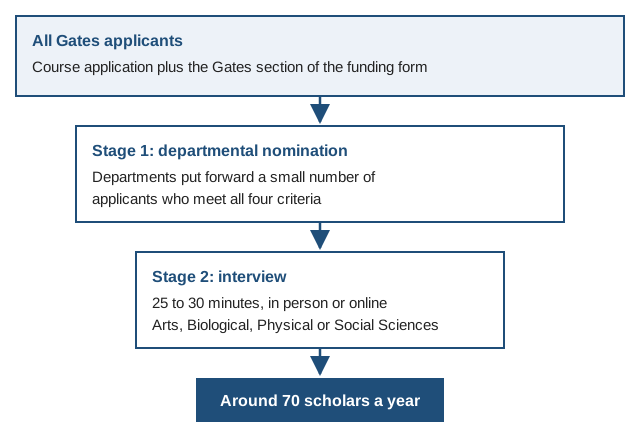
That makes the course application the first gate. Many strong candidates are eliminated because their department did not rank them highly enough, and the scholarship case is never weighed. The course application has to hold up on its own.
Among nominated candidates, the criterion that most distinguishes Gates from other Cambridge funding is commitment to improving the lives of others. An excellent researcher who can show how their work helps other people is a stronger candidate than a brilliant one with nothing to show on that front.
The four criteria
Gates Cambridge selects on four criteria, and every part of the application is read against them:
- Outstanding intellectual ability, shown through transcripts, references and experience.
- Reasons for choice of course: a strong case for this degree at Cambridge. PhD and most research MPhil applicants need to contact a potential supervisor first.
- A commitment to improving the lives of others, which applicants are free to define for themselves.
- A capacity for leadership, past and future.
The 2027 timeline
Applications for 2027/28 opened on 11 September 2026. There are three deadlines, depending on who you are and which course you choose:
- US citizens resident in the US: 14 October 2026
- Most other applicants: 8 December 2026, the main international round
- Some courses: 6 January 2027
The Cambridge course directory shows which applies to your course. For the international round, the published stages are:
- 8 Dec 2026 or 6 Jan 2027Full application, including all references, submitted by 11:59pm UK time.
- Dec 2026 to Feb 2027Departments rank applicants and make nominations.
- By 8 Mar 2027Every applicant is told the outcome of their application.
- 22 to 23 Mar 2027Interview panels meet and select scholars.
- Early Apr 2027Scholarships offered. Offers must be accepted within 72 hours.
The US round runs earlier, with panels on 22 and 23 January 2027 and offers by early February.

What the scholarship covers
| Component | What Gates Cambridge pays |
|---|---|
| Fees | The University Composition Fee at the appropriate rate |
| Maintenance | GBP 23,152 for 12 months at the 2026-27 rate, pro rata for shorter courses; up to four years for PhD scholars |
| Travel | One economy single airfare at the start and one at the end of the course |
| Visa | Inbound visa costs and the Immigration Health Surcharge |
| Children (discretionary) | Up to GBP 12,793 a year for one child, or up to GBP 18,244 for two or more. Nothing is paid for a partner |
| Academic development (discretionary) | From up to GBP 750 to up to GBP 4,000, depending on course length, for conferences and courses |
| Other discretionary support | Maintenance during PhD fieldwork, up to six months of paid parental leave, and hardship funding |
Gates does not pay bench fees or scientific equipment, which it expects the department to cover. If you receive a salary or another substantial scholarship, the Trust may reduce or withhold the maintenance allowance, and if a public body such as UKRI offers you a fee award you are expected to accept it.
Eligibility
- Citizen of any country outside the United Kingdom
- Applying for a PhD (full-time, or part-time under a pilot scheme), a full-time MLitt, or a full-time one-year postgraduate course such as an MPhil
- A strong undergraduate academic record
- A clear case for Cambridge and your course, with evidence of leadership and commitment to improving the lives of others
Some courses are excluded. Gates does not fund undergraduate degrees, including a second BA as an affiliated student, MASt courses, part-time degrees other than the PhD, or professional programmes such as the MBA, MFin and PGCE. Check the full list on the Gates eligibility page before you choose a course.
There are no limits on nationality (beyond the UK exclusion), age or field. Unlike Rhodes, Gates Cambridge has no age cap, and it funds everything from the humanities to the sciences. Current Cambridge students can apply for a new course, but not to fund the rest of a degree they have already started.

The Gates questions
The Gates part of the funding form asks four questions, one for each criterion:
- How you have displayed academic excellence (about 200 words, up to 1,400 characters)
- Why this specific Cambridge course, and how it will help your future plans (about 200 words, up to 1,400 characters)
- Examples of your commitment to improving the lives of others, why it matters to you and how it fits your plans (about 300 words, up to 2,100 characters)
- Examples of your capacity for leadership and how it will help you make an impact (about 300 words, up to 2,100 characters)
These answers are used to separate candidates who have already been nominated, so they are read by people who have seen a lot of good applications. The limits are short. Specific examples carry more weight than mission-statement language, as the illustrative pair below shows for the third question.
The Cambridge case should be specific too: the supervisor, lab or course structure you need, and why it cannot be found elsewhere. For PhD applicants, Gates also needs a research proposal, which most will already have uploaded for admission.
References
Gates applicants need two academic references for admission and one additional Gates Cambridge reference. That third referee is asked to assess you against all four criteria, rank you within a group they name, and rate you as exceptional, strong, not strong or weak.
Choose someone who knows your character as well as your work: a former adviser, an employer or a senior person in an organisation where you volunteered. One of your academic referees can write it, as long as the letter addresses the Gates criteria and is not a third academic reference. Brief whoever writes it on the criteria, and remember that all references must arrive by your deadline. Our guide to asking for a recommendation letter has a template for the request.
The interview

Nominated candidates have a 25 to 30 minute interview with one of four subject panels: Arts, Biological Sciences, Physical Sciences or Social Sciences. Panels include academics and practitioners and may include Gates alumni. Expect questions on what you know about Gates Cambridge and why you applied, on your academic work, course choice and career plans, and possibly an ethical or intellectual question with no right answer. Gates does not give feedback to unsuccessful applicants. Our guides to panel interviews and video interviews cover preparation.
For applicants with an excellent academic record but little to show on service or social impact, a course-specific Cambridge scholarship or a research-council studentship may be a better target, and these can be applied for alongside Gates.

How to apply
- Apply for your chosen Cambridge postgraduate course through the University’s postgraduate application portal.
- In the funding section, complete the Gates Cambridge sub-section: the four questions, and a research proposal if you are applying for a PhD.
- Register two academic referees and one Gates Cambridge referee, and brief them early.
- Submit everything before 8 December 2026 for the main international round, or by the earlier or later date that applies to you (14 October 2026 for US citizens resident in the US; 6 January 2027 for some courses).
- If your department nominates you, interview in March 2027 (January for the US round). Offers are made by early April and must be accepted within 72 hours.
Deadlines and figures change each cycle. Confirm the current details on the official Gates Cambridge site before applying.